









Each week multi-site bakeries have the challenge of understanding why stock was left over at one bakery while a product opportunity was missed at another – and the answers can arrive way too late to take swift action.

Every Monday morning, in most multi-site bakeries, the same questions come up. Why did the sausage rolls run out by 2pm last Tuesday? Why were trays of iced buns left over at the station shop on Saturday? Why did the new sandwich range fly in one town while the bloomers sat on the shelf in another?
Each one points to money left on the table, in lost sales or in stock thrown away at closing. And each one, if answered properly, tells a business something it can act on next week.
The trouble is that most of these questions never get a proper answer.
The difference between what and why
Most bakeries can tell you what happened: the till system records every sale. So, with enough time, someone can work out that a product sold out early or that a shop had a weak weekend.
Why it happened is much harder. A sell-out might be down to the weather, a school holiday, a local event, a promotion, or a change in day of week behaviour that nobody has noticed. Usually, it is a mix. Untangling that means comparing shops, days, products and periods, exactly the kind of work that takes hours in a spreadsheet.
So the question gets asked in the weekly meeting, someone promises to look into it, and by the time they have, there are five new questions on the table.
Why the answers stay out of reach
In many multi-site businesses, the ability to dig into the numbers sits with one or two people. Everyone else, from the area manager to the shop supervisor, has to send their question to head office and wait. And when those people are off sick, on holiday or tied up with month end, the questions queue up until they are back.
Questions that should take seconds end up taking days. Many are never asked at all, because people know the answer will arrive too late to matter. The shop manager who suspects their Friday order is wrong keeps ordering the same, because proving it would take more time than they have.
Many systems already provide data, and dashboards help, but only with the questions someone thought to build in. Ask something new and it is back to exporting data. And data alone is not enough. What operators need is the reason behind the numbers and a clear recommendation on what to do next.
Turning questions into patterns
When the why stays hidden, the same problems repeat. A product sells out every bank holiday, but nobody connects the pattern, so production never changes. A promotion is judged a failure when it worked in half the shops. Waste creeps up in one region and nobody can explain it.
The bakeries pulling ahead are the ones that make it easy to ask why. They give the people closest to the shops direct access to their own numbers, so a question raised on a Monday is answered on a Monday. They look for patterns across the whole estate, not just within one site, and they treat the first answer as the start of a better second question.
The result is not just less waste or fewer empty shelves. It is a business that learns from every week instead of repeating it.
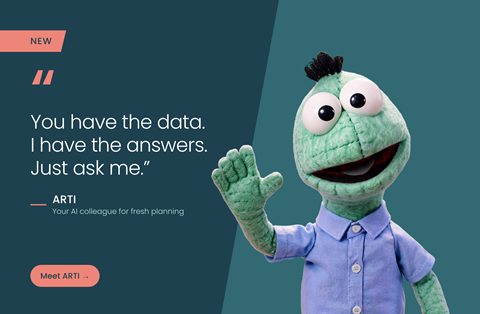
Meet Arti, from foodforecast
Since 2019, foodforecast has been helping bakeries predict demand for ultra fresh products through AI demand forecasting. Powered by machine learning, it tells operators how much of each product to bake, and today it runs across more than 6,000 points of sale in Germany, Austria, Switzerland, the Netherlands, France, Hungary and the UK. We work with small and large bakeries, food companies and enterprise customers.
Working with bakeries every day, we kept hearing the same thing: they had the data, but not the time to get answers from it. So we built Arti.
“Arti explains what happened, and foodforecast’s prediction tool predicts what will happen next”
– Greg Nixon, UK Country Lead, foodforecast
Arti is a knowledge base built on a bakery’s own sales data. Anyone in the business can ask it questions in plain English. An area manager can ask which products keep selling out early on Fridays, or whether certain shops struggle after a bank holiday, and get an answer or a full report in seconds.
Arti also builds reports in seconds. Managers can compare every site or just a chosen few, see the best and worst performing products and shops, or ask for last week’s sales compared with the same week last year. Weekly, monthly and yearly reports can be produced just as quickly, without anyone touching a spreadsheet.
For those who would rather not ask at all, Arti sends automated weekly reports to the right people: a shop manager for their site, an area manager for their region, or head office for the whole estate.
The two work on their own or together. Arti explains what happened, and foodforecast’s prediction tool predicts what will happen next.
So the next time someone asks why something sold out, the answer will be a question away, or already sitting in their inbox on Monday morning.
To discover more, take a look at this short video about Arti:
To discover more on how Arti and foodforecast can help you otpimise your multi-site sales, contact Greg.Nixon@foodforecast.com or visit www.foodforecast.com/en