






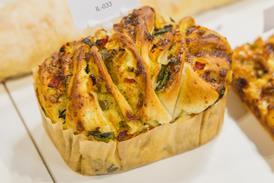

Making a good cake starts with the recipe. Producing thousands with the same volume, texture, colour and appearance requires a clear understanding of how ingredients and every stage of the process interact.
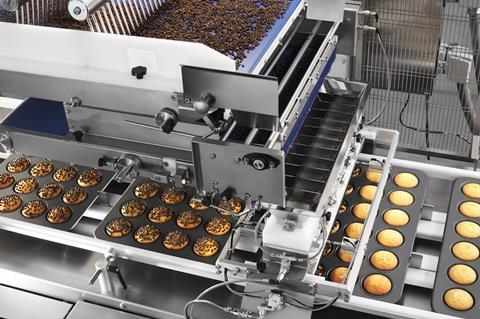
A simple product with a complex process
Cake is familiar, but industrial cake production is far from simple. Manufacturers are expected to deliver products with consistent weight, height, crumb structure, colour and sensory quality, often across increasingly varied portfolios. A small formulation or process change can influence several of these characteristics at once.
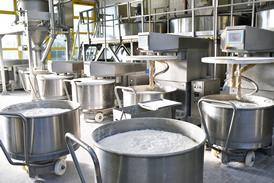
This is why cake quality cannot be assigned to a single recipe, machine or inspection point. It develops progressively, from ingredient selection and mixing through batter transfer, depositing, baking, cooling, filling, icing and packaging. Every transfer can change time, temperature, shear, moisture or position, and every change can alter the finished product.
Ingredients perform more than one job
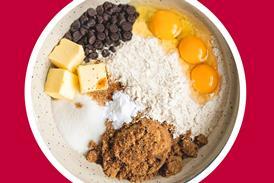
A recipe may look like a list of quantities, but each ingredient performs structural, textural and sensory functions. Eggs support emulsification, aeration, moisture retention and structure formation. Sugar contributes not only sweetness, but also air-foam stability, gas retention, browning and crumb softness. Fat influences aeration, tenderness, mouthfeel, volume and shelf-life.
These functions are interdependent. Reducing sugar or fat, replacing eggs, adding fibre or introducing new protein sources not only removes one characteristic; it changes the balance of the batter and may affect viscosity, air incorporation, heat response and structure setting. Reformulation therefore needs to consider not only what replaces an ingredient, but also how the process must adapt to the new formulation.
Batter condition connects recipe and equipment
The batter is the link between formulation and line performance. Temperature, density, aeration, mixing history and hold time influence how it flows, how accurately it can be deposited and how it develops in the oven.
If batter becomes warmer, older or exposed to excessive shear, its flow behaviour may move outside the intended range. The result can appear as variable deposit weight, tails, poor cut-off, uneven inclusions or inconsistent shape. With inclusions, the challenge becomes even more demanding: the batter needs enough structure to suspend the pieces, while remaining processable through the depositing system.
More sophisticated products multiply these interactions. In a two-colour marble cake, for example, the two batters must be considered separately. A visually simple swirl is therefore the result of controlled interaction between formulation, batter condition, dosing and heat transfer.
Depositing is the first visible expression of process control
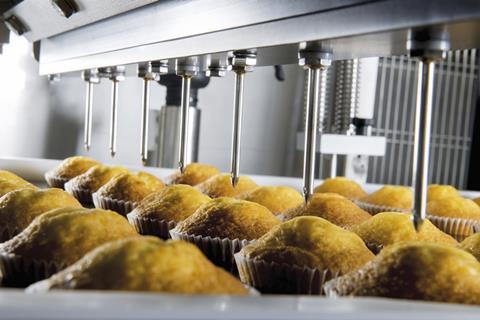
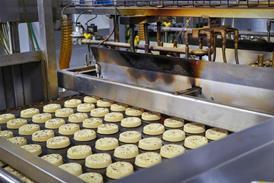
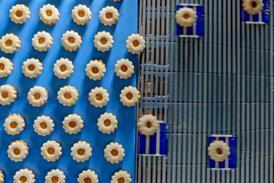
Accurate depositing is often discussed in terms of portion weight, but the deposited geometry also influences what happens next. Mass, footprint, cup fill level, cut-off and position can affect expansion, heat penetration and final shape. A consistent oven profile cannot fully compensate for inconsistent deposits entering the oven.
Baking is a sequence of heat-transfer decisions
Inside the oven, cake baking is a simultaneous heat- and mass-transfer process. Conduction from the tray or mould, radiation from heated surfaces and convection from moving air do different jobs. Their balance influences expansion, core heating, structure formation, moisture removal and surface colour.
This means that an oven temperature alone does not describe a baking process.
Early in the bake, the product needs enough energy to support expansion and structure development without setting the surface too quickly. Excessive early top heat can create premature crusting and restrict expansion or lead to peaking. Later in the process, moisture removal and colour development become more important. A multizone or hybrid approach can therefore be useful when different heat-transfer modes are required at different moments of the bake.
The finished cake is evidence, not just an outcome
A visible defect often appears downstream from the condition that created it. A low or collapsed muffin may point to unstable aeration, excessive leavening, aggressive early heating, insufficient core set or cooling shock. A gummy centre may originate in mixing, emulsion stability, deposit mass or inadequate heat transfer. Uneven browning may reflect oven distribution, but it can also be influenced by deposit weight, bakeware, surface moisture or the formulation itself.
The finished cake should therefore be read as process evidence. Standardised cross-sections, colour maps, weight checks, height measurements and temperature histories can help trace a defect upstream. The aim is not to adjust everything at once, but to identify the most likely process block, change one causal factor and repeat the sample under controlled conditions.
Complexity continues after the oven
Cooling, filling and icing are sometimes treated as finishing steps, but they create their own product interfaces. A cake must be sufficiently cool and structurally stable before injection. Filling temperature, viscosity, needle position, pressure and stroke influence fill weight, centring, leakage and crumb damage. Water-activity differences can also affect product stability during storage.
Testing creates a safer route to scale
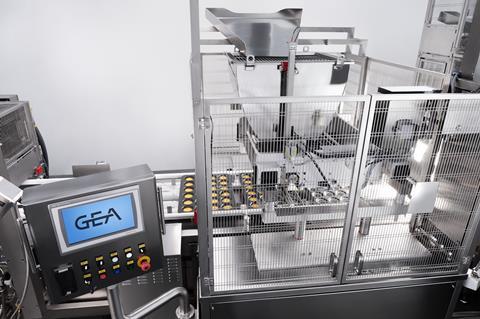
Moving from a promising recipe to industrial production is not simply a matter of increasing volume. Scale changes mixing energy, transfer conditions, residence times, heat distribution and the way a product is handled. Pilot trials create an intermediate environment in which recipe and process can be developed together under representative conditions.
At the GEA Bakery Experience Center in Verona, food technologists and process specialists work with manufacturers to analyse raw materials, refine formulations, test process parameters and assess the finished product before full-scale implementation. The objective is not only to demonstrate that a product can be made, but to define a repeatable process window and identify risks before they reach commercial production.
This turns scale-up into a learning process rather than a single pass-or-fail test.
Develop the product and the process together
The most resilient development approach is therefore an integrated one. Ingredients, batter behaviour, equipment settings, heat transfer and post-bake handling should not be optimised in isolation; they should be treated as parts of the same product system.
A successful recipe is only the beginning. The real goal is to develop a product and a process that are ready to scale together.
To find out more about GEA Bakery’s solutions for successful upscaling and reformulation, click here.