








Fix, rebuild, and grow – that’s been the goal for Renshaw over the past two years since it was rescued by British Bakels after former owner Real Good Food went into administration.

The “incredibly busy” period for managing director James Cawthorne and the team at British Bakels has seen the cake decoration firm’s employees and systems integrate into the wider company, as Bakels aimed to get the heritage brand back on its feet and ready for growth.
First came the fixing. There’s been “a heck of a lot of change” in the Renshaw business over the last couple of decades, notes Cawthorne adding that he wanted to create stability for customers and employees, some of whom have been with Renshaw for 20 or 30 years.
“Our key focus really in 2024 was supply and making sure customers got what they had ordered,” Cawthorne tells British Baker. “It’s probably well known that they [Renshaw] had some struggles being able to supply and supply consistently.
“That is everything,” he says, “because without your customers you don’t have a business. So, we had to rebuild some reputation, and I do believe that British Bakels was able to do that.”
“We are a much broader assortment supplier to our customers now than we ever have been”
Getting Renshaw back on its feet has added another weapon to Bakels’ arsenal, with the Liverpool production facility (where Renshaw products are made) being utilised by the wider business with some NPD for the Bakels brand being manufactured at the site.
“We are a much broader assortment supplier to our customers now than we ever have been,” he states. “We can supply through British Bakels base raw materials, whether that’s cake mixes, bread mixes, custards, fillings and toppings – you name it. But also, we can supply everything else out of Liverpool, whether that’s marzipans and cake decorations, icings, buttercreams and fondants.”
With supply steady, the next step was understanding what the Renshaw brand stood for, the emotional attachment people had to it, and how British Bakels could lean into that for the future. Part of this involved bringing the Renshaw Cup back after 21 years to continue the tradition of honouring emerging talent in the baking industry. Having spoken to John Renshaw, Cawthorne says it was a “no brainer” to reignite the competition, albeit with a modern twist.

A sprinkling of creativity
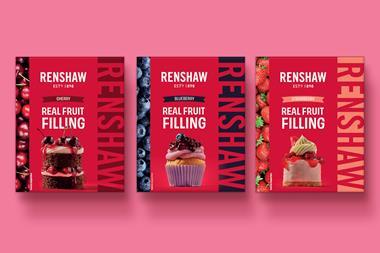
The next modern twist came in the form of NPD. The first new products for Renshaw under its Bakels ownership were unveiled last month with the line-up comprising food colourings, metallic paints, sprinkles, and fruit fillings.
Some of the products, notes Cawthorne, were designed to expand the Renshaw range in line with customer demand and creativity needs, and some of them were about ensuring the brand offered a “baseline of complementary products” because “it’s not a complete range without them”.
Taking the fruit fillings as an example, the MD questioned what was out in the marketplace. The answer: “not a lot”. But is it something customers want? “Yes”.
“We conveniently have a business within the group that manufactures high quality fruit fillings so we could leverage the power of the group to be able to do that,” he explains.
As for the colours and glitters, Renshaw has experience of selling those in the past with customers asking: ‘when will you be bringing those products back?’


“We felt that it was a huge gap for the Renshaw business. Yes, those products are in the market elsewhere, but they’re not under the Renshaw brand,” he adds.
So, what’s so special about the Renshaw brand? For starters, it’s “loved by millions of people around the world”. This, Cawthorne believes, is due to the reliability and quality of the products as well as the breadth of the range on offer. There are more than 130 lines available on Amazon, for example.
“The Renshaw brand has been able to carve itself out a niche for allowing and providing solutions for bakers, whether they’re semi-professionals or professionals, to really explore and be really creative.”
For Cawthorne, the product launch is “part of the stabilisation of the business”. “It’s next year, the year after, and the year after that that we’re really excited about because those are the ones where we can start thinking about what is truly new,” he adds.
Nothing is off the table at this point allowing the team to flex their creative muscles. “I do believe the Renshaw brand has the capability to stretch further into all elements of home baking, whether that’s non-food, kits, powders, brownie mixes, and cookie mixes,” the MD enthuses.
Building for the future
Cawthorne takes his role as Renshaw’s “custodian” very seriously and it’s clear from the way he talks about the business that he believes in the power of the brand and its potential. Every decision is designed to make sure he can “hand it over to the next generation in better shape”.
“I’m invested in it at a level that’s probably way beyond what anyone would expect,” he enthuses. “I get involved in the products, I like to understand how we make things, and why that piece of equipment is better than that piece.
“They’re not items on a spreadsheet. We develop and manufacture fantastic products and we’re all in it, in the detail – that’s what makes a difference.”
A short history of Renshaw
- 1898: John F Renshaw & Co Limited was founded, with its first premises situated on Great Portland Street, London. Marzipan was the first product to be created and remains part of the range to this day
- 1930s: Renshaw starts exporting to New Zealand, Argentina and Mexico
- 1950s: The firm was granted its first Royal Warrant by King George VI in 1950 followed by Queen Elizabeth II and The Queen Mother in 1955
- 1980: Renshaw merged with Liverpool-based manufacturer Allmey & Layfield
- 1991: Production moves to Liverpool
- 1990s: Schwartau acquired the business, with £16m invested over the next decade
- 2005: Renshaw becomes part of Real Good Food Company (RGF)
- 2023: British Bakels acquires Renshaw after RGF falls into administration
- 2025: British Bakels unveils first NPD for Renshaw since acquisition





No comments yet