










What a difference a year makes – 2025 saw the doughnut market reshuffle as players re-evaluated plans, sought new owners, and in several cases shut shops to ensure their future.
But 2026 feels different, decidedly more positive. Despite the continuing challenges, many operators are surefooted about the next steps, with several securing investment, partnering with innovative brands on NPD, and gearing up for growth.
Family-owned Dum Dum, Midlands-based Doughnotts, and independent doughnut and coffee chain Deep North are just a handful of those to be investing in expansion.
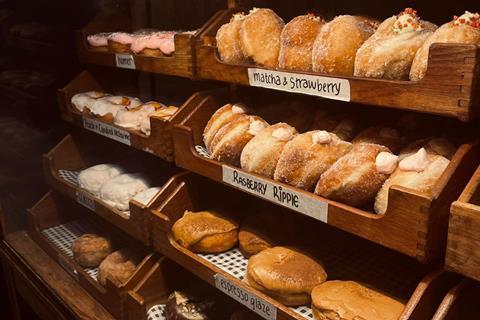
So, what’s changed? And how are businesses reaping the benefits and continuing the positive momentum for years to come?
There isn’t a singular answer. Instead, the shift reflects a myriad of factors which have turned the dial in favour of doughnuts and the people who make them to deliver modest growth. That’s not to say everything is hunky dory, but the overall the mood in the market is more upbeat than a year ago.
“People aren’t eating fewer doughnuts; they’re just being more selective about which ones make the cut,” explains Crosstown CEO Jo Blundell. “Even with tighter budgets, consumers are happy to spend if the quality, craft, and flavour are there to justify it.”
Indeed, at a time when costs remain high, doughnuts, even premium ones, represent an affordable treat, particularly when compared to the likes of eating out at restaurants.
What’s more, the availability of doughnuts is increasing as different types of businesses look to stock them, with suppliers more than happy to meet demand.
“The UK doughnut market is shifting from a fragmented, craft-led space towards a large-scale, multi-channel category dominated by fewer big players,” says Lisa Kerr, senior marketing manager at Puratos UK, noting that growth is now driven by “bakery chains, coffee shops and specialist brands using centralised production and industrial bake-off to scale efficiently”.
“Doughnuts are no longer ‘specialist only’,” Kerr adds, pointing to the likes of forecourt operators, such as BP, and casual dining restaurants serving them without the need for “in house expertise”. “We’re even seeing larger scale producers borrow formats usually seen in artisan shops, such as filled rings, hybrids and loaded styles.”

M&S is among the retailers to capitalise on this with a range of Dunked N’ Loaded doughnuts rolled out at 600 of its Foodhalls. Boasting an ‘ultra-light dough’ with a generous helping of premium filling, they come in Strawberry & Matcha, Chocolate, Pistachio, and Lemon flavours.
This trend, according to supplier CSM Ingredients – and sponsor of National Doughnut Week which takes place from 16-24 May 2026 – will only increase going forward.
“Over the next 12 months the number of occasions that doughnuts are consumed at will increase via the consumption of desserts at home and as snacks with ‘snackification’ increasing across Gen Z and driving demand,” states Mike Wilde, technical account manager at CSM Ingredients. “Desserts are fast becoming the only reason why diners are eating out or buying to take home and because of this there will be an increase in consumption of premium doughnuts that deliver theatre via bold colour and ingredients used for toppings and fillings.”
Filling the hole in wholesale
It’s important then that doughnut producers ensure their wares are in the right locations.
“There’s clear opportunity in wholesale and partnerships, especially within premium coffee and hospitality,” according to Crosstown’s Blundell, adding that e-commerce and gifting are also growing fast as doughnuts are increasingly seen as a premium, shareable gift.
Retail expansion still matters, she adds, but its important to be selective, choosing high footfall locations with strong brand alignment rather than “scale for the sake of it”. Crosstown now has four concessions in Waitrose stores, including locations beyond London, helping it to reach “more affluent customers outside of the capital in addition to our Oxford and Cambridge sites”.
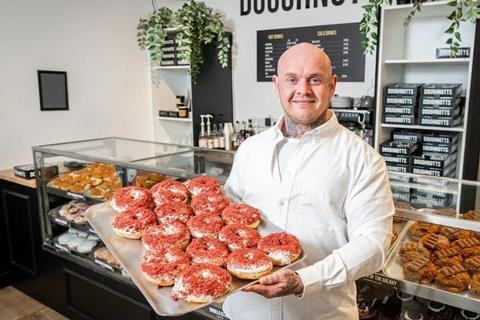
Midlands-based Doughnotts, one of the businesses which has secured funding for growth recently, also describes wholesale as a “key growth channel”, especially with partners looking to improve their food-to-go offering. “Expanding our own retail stores and franchise network is another big focus, alongside delivery and online ordering. The flexibility of doughnuts as a product means they work well across multiple channels and occasions,” co-founder Wade Smith explains.
The six-figure funding packaging will be used to help Doughnotts build a “robust and scalable franchise model that allows us to expand while maintaining the quality and brand experience we’re known for”. Smith notes the firm is taking a “phased approach” to growth, prioritising the right locations and partners with the aim of steadily increasing its estate over the next few years.
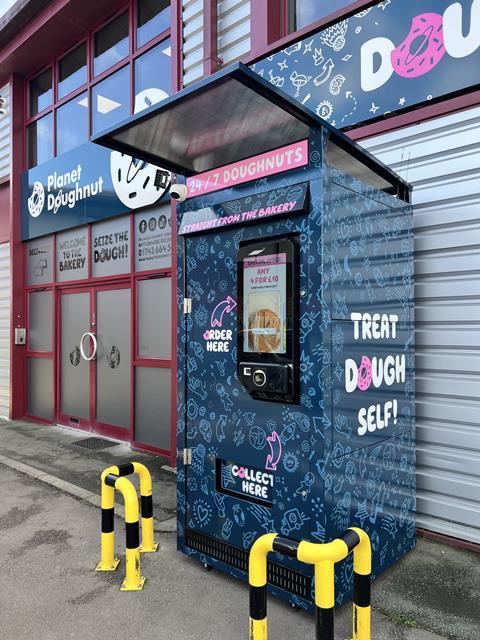
Shrewsbury-placed Planet Doughnut, meanwhile, was among the firms to previously re-evaluate its estate. In 2024 it made the tough decision to close all of its stores to instead focus on a frozen model with doughnuts blast-frozen immediately after production – unless they’re heading straight to the recently unveiled doughnut vending machine outside its offices, that is.
The technological innovation signals the firm’s desire to grow in the leisure space with discussions in place with potential partners, including theme parks, holiday parks, and other leisure and amusement venues about hosting vending machines on their estates.
Alongside this, managing director Rob Jones outlines Planet Doughnut’s ambitions to continue its streak of double-digit growth year on year. “We invested in our very own dedicated development kitchen at our bakery and HQ at the back end of last year which has already yielded a number of new products that are propelling our growth in 2026,” he says. Although keeping his cards close to his chest, Jones notes that he’d be “disappointed if we don’t see six-figure sales from new and innovative products that have already been born in our development kitchen”.
NPD is a core part of artisan bakery Pipp & Co’s strategy as well, although alongside a raft of new doughnuts it is expanding with other bakery items such as cakes, pastries, and croissant cones.
“Rather than indicating a decline in demand for doughnuts, this move highlights an opportunity to diversify and capture additional occasions for indulgence, while strengthening our brand’s overall market presence,” explains Pipp & Co’s co-owner Betina Evangelista, with the firm producing 25,000 doughnuts a week and counting.
The Swindon-based, family-run business supplies products to independent retailers and caterers, as well as direct to customers via its Bristol café and production bakery. However, Evangelista says it has secured two new store openings scheduled for later in 2026 as well.
It comes after what the co-owner describes as a year of “significant change and challenge”, noting that the business has taken time to “review and refine our systems, focusing on improving efficiency so we can dedicate more time to fulfilling customer orders and developing new flavours”.
Expect the unexpected in flavour town
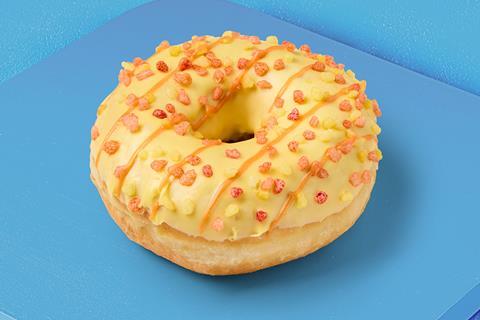
Indeed, new flavours keep the hype alive in doughnut world offering consumers another reason to visit (and something interesting to share on their socials).
“Flavours will be bolder with layered fillings, sour profiles, sweet-and-sour contrasts and unexpected collaborations,” says Mike Wilde at CSM Ingredients. One example of this is unconventional flavour twist is ‘swour’ – doughnuts with sour notes combined with inspiration from confectionery.
“From mango and pineapple to peach and strawberry combined with sour cherry, lemons and raspberries will be hugely important in doughnut flavours, toppings and fillings,” he adds. “Totally tropical on its own will be a key theme this year, in both flavour and visual appeal.”
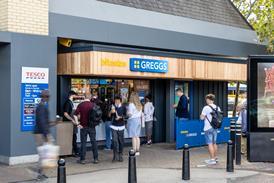
One example of a tropical themed doughnut is from Greggs which recently added a Mango & Passion Fruit Doughnut to its range. The ring doughnut has a mango & passionfruit filling, topped with mango & passionfruit flavour icing and sugar pearl decoration.
Another example comes from free-from specialist Borough 22. It teamed up with Anguillan-born chef Kerth Gumbs last year to create the Soursop Drop doughnut. The Caribbean fruit was used in a vibrant doughnut with a creamy soursop custard centre, mango glaze, and crispy plantain chips on top.
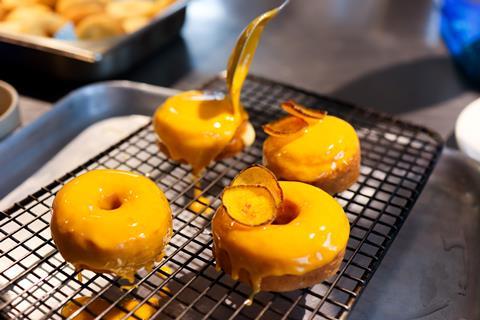
The use of the plantain chips on top points to another trend – something Lisa Kerr at Puratos UK has dubbed the rise of “super sensory” doughnuts. With “bold flavours, vibrant glazes and layered textures” they deliver “a more immersive, treat-led experience, often boosted by seasonal and limited-edition launches”, she explains.
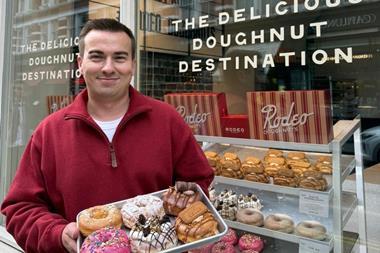
The aforementioned M&S Dunked N’ Loaded doughnuts which are filled, glazed, and topped with textural elements such as freeze-dried strawberries fit neatly into this trend. While newer for retail, the likes of Rodeo Doughnuts with its indulgent treats has been doing this for some time.
All of this builds into the excitement of the experience. “From marshmallow cream fillings to ‘grandma-core’ flavours such as apple, cinnamon, layered texture, mystery fillings and surprise centres add theatre and encourage repeat purchase,” says CSM Ingredients’ Wilde.
A collab for the ages
There’s also continued demand for collaborations and licensing deals, from the wider food & drink world and beyond it.
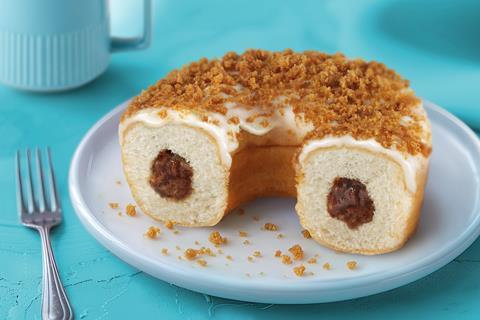
The bestselling filled doughnut at Warrens Bakery, for example, is a Biscoff one. This is echoed by Rodeo founder Thomas Anderson who says the firm’s top two are Biscoff and Kinder Bueno. Baker & Baker, meanwhile, has recently partnered with Cinnabon to bring doughnuts inspired by the firm’s iconic cinnamon rolls and cream cheese-style icing to in-store bakeries.
Jo Blundell at Crosstown describes collaborations as a “a central part of our DNA”. There was a cosy autumn collab with sofa brand Loaf, to a dark chocolate sourdough drop inspired by Warner Bros’ film The Bride, and a Mother’s Day range with Revive collagen-infused compotes.
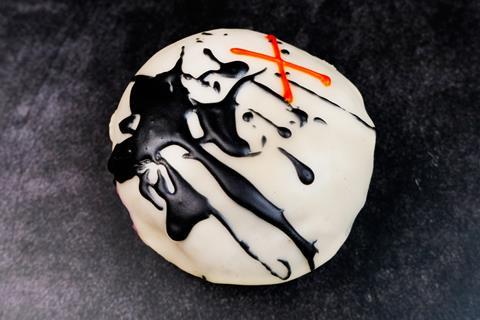
Krispy Kreme has also made collaborations a core part of its NPD strategy with partnerships with matcha brand Perfect Ted and KitKat among recent launches.
“We partner with a wide spectrum of partners from confectionery brands with established followings to emerging challengers that bring innovation and flexibility,” Guy Meakin, managing director of Krispy Kreme UK & Ireland says. “Our Pistachio Overload partnership with Black Milk was a brilliant example of the latter, with their expertise allowing us to quickly capitalise on the customer demand for pistachio products.”
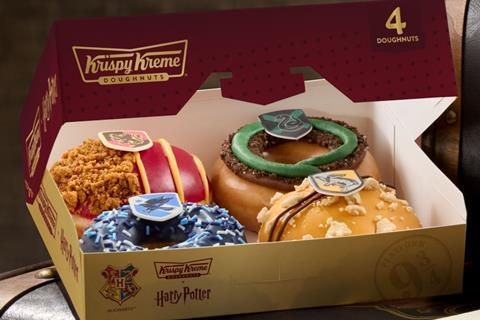
However, the collabs Krispy Kreme fans get most excited about, according to the MD, are those that tap into cultural franchises. The Harry Potter range is one example of this. Alongside four doughnuts inspired by the Hogwarts houses – Gryffindor, Hufflepuff, Ravenclaw, and Slytherin – the brand created a Sorting Hat doughnut which included an element of gamification with customers discovering their houses through one of four hidden fillings.
All about that base
Eye-catching toppings certainly lure customers in, but good eating properties keep them coming back for more. As such, many doughnut producers are turning their attention back to the dough.
“Toppings once dominated NPD, but the attention is slowly shifting to the base of products,” believes Baker & Baker UK R&D director Jonathan Adams. “This allows manufacturers to upgrade the base so that it is no longer just a carrier, but a point of differentiation.”
Sourdough, Adams highlights, is now part of the premiumisation story thanks to its “longer prove and complex flavours”.
It’s something Crosstown has been doing since its inception. Pipp & Co, meanwhile, favours a brioche dough for its generously filled creations.

Doughnotts has also been investing in the dough, as co-founder Wade Smith says the firm has “invested heavily in research and development to refine and improve our dough recipe focusing on texture, flavour and consistency”. “That work underpins everything we do, ensuring every doughnut delivers the quality our customers expect,” he adds.
What’s more, differentiation in bases is also opening new doors for new formats and hybrids.
“The blurring of bakery concepts shows no sign of slowing down and this trend opens up new opportunities to broaden appeal further with consumers,” adds Adams. “We are now seeing interesting variants, such as mochi doughnuts and doffles (doughnut waffles).”
He also points to cross category hybrids such as hot cross doughnuts or cereal doughnuts.
There’s a lot to consider, but plenty of opportunity to keep the market, its players, and consumers sweet for the year ahead.
ADVERTISEMENT: CSM INGREDIENTS

Thank you to all the incredible bakers, partners, and supporters who make National Doughnut Week sponsored by CSM Ingredients possible. Your generosity has helped raise over £1.18 million for vital charities, including The Children’s Trust. Together, you are making a meaningful difference to thousands of children and families across the UK.







No comments yet