








Shifting consumer mindsets and stronger innovation is helping lead the UK’s free-from cake market into a new phase.
It hasn’t been without its struggles over the last few years, compared to high flying free-from bakery categories like bread and morning goods, “but we’re starting to see positive momentum return” comments Ola Evans, commercial & development controller at manufacturer Finsbury Food Group.
The latest year has been very promising indeed, with a 9.4% increase in value and 6.4% in volume for the total free-from cake market [52 w/e 25 April 2026].
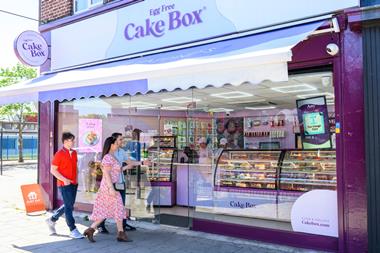
While demand was once largely driven by medical or dietary requirements, it has now become more mainstream. “Increasingly, customers are choosing free from options because they fit their lifestyle, values or preferences, rather than because they have to,” says Sukh Chamdal, CEO of Cake Box, which recently reported a 12% rise in annual sales to £46.7m for its egg-free cake retail brand.
Shoppers may not have a diagnosed intolerance but notice when a certain food affects them, notes Lorna Love, director of sales and marketing at free-from sweet bakery brand Lazy Day Foods. She cites 2025 figures from the Food Standards Agency that have a third of adults reporting an adverse reaction to certain foods, while an estimated 4% have a food allergy and 12% have diagnosed food intolerances. “Milk and gluten remaining the most commonly reported,” she adds.
So what trends are driving the UK’s free-from cake market, what are the biggest players and innovations over the past year, and what opportunities remain?
Quality eat
Just like with free-from breads and other savoury bakes, people are now much less willing to accept a compromise in quality of free-from cakes. And regardless of whether they are free from or not, consumers want them to feel indulgent.
“Retail has come a long way in free-from, especially around quality and variety, but out-of-home still has a lot of catching up to do,” notes Evans at Finsbury. She singles out M&S as having “done a good job in their cafés” by offering a wide range of gluten-free muffins, scones and iced buns” whilst noting there’s “still a big gap across the wider café market where the range can feel very limited”.
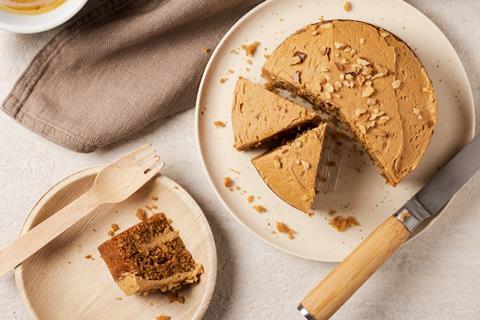
Advances in ingredient functionality have meant free-from cakes are now much closer to standard equivalents in terms of texture and shelf life. This in turn has supported a rise in demand, which then poses the challenge of consistency. “That’s where dependable mixes and ingredient systems are key, helping smaller operators scale up without losing control of quality,” comments Dan Jones, marketing manager at ingredients supplier British Bakels.
At sweet bakery manufacturer Baker & Baker, there’s been a notable uplift at the premium end of the free-from cake category, according to head of customer innovation Jacs Edwards. “Although the frequency of such purchases may not be as high, we are seeing a trend for consumers wanting to treat themselves within free-from,” she adds.
Big three brands
Own-label ranges may be dominating the gluten-free cake category in retail, accounting for 71% of unit sales [Circana data, 52w/e 5 May 2026], but its growth has stayed relatively flat at 1% year on year. Instead, its innovation-led brands that are driving market gains.
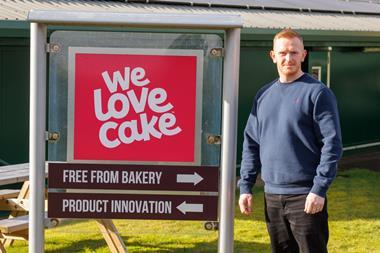
An 80% share of the branded free-from cake market is spread across just three key players – Lazy Day Foods, Mrs Crimble’s, and We Love Cake – according to Josh Boydell-Smith, head of brand and marketing at Bells of Lazonby, which manufactures the latter’s range at its bakery in Cumbria.
We Love Cake continues to outperform the wider market and deliver strong annual growth of 28% in value (to over £66k) and 22% in volume (more than 99k packs). These gains have been supported by a consistent pipeline of relevant innovation and increased retail distribution, says Boydell-Smith, with an exit in desserts affording a harder push in cakes. Last year, the brand was inspired by the “booming popularity of cinnamon buns” to launch new Cinnamon Swirl Cake Slices, and more recently tapped into a British classic for its Carrot Cake Slices.
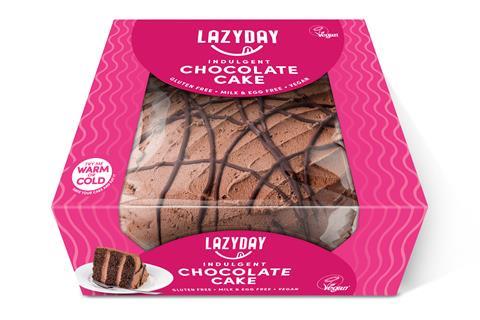
Investment in NPD, coupled with new supermarket listings and expansion in foodservice and travel channels, have helped drive 15.1% year-on-year growth at Lazy Day. The company, which produces its range of cakes, traybakes and shortbread at a bakery midway between Edinburgh and Glasgow, is also looking to enter more overseas markets after receiving support and guidance from Scottish Enterprise last year.
Mrs Crimble’s, meanwhile, was first established back in 1979 and is now made by B Corp-accredited manufacturer Ecotone UK at its site in Camberley, Surrey. The brand has expanded beyond macaroons into cake formats including madeleines, which have proven themselves a strong performer with rate of sales doubling year-on-year [Circana, 22 February 2025].
Up and on-the-go
Good things come in small packages, so they say. The free-from cake market seems to agree with growth mainly coming in all-year-round formats like slices, squares, and cake bars.
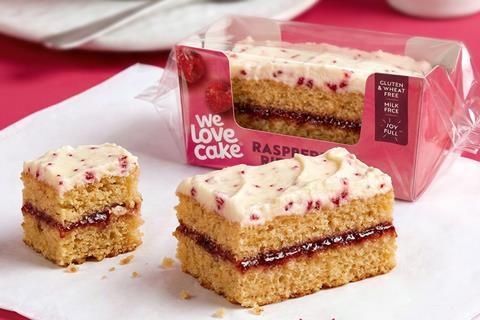
We Love Cake has moved into individually wrapped, single-serve slices for foodservice, which Boydell-Smith says reflects a wider strategy to drive accessibility and unlock new consumption occasions, particularly in out-of-home and grab-and-go environments. “By providing operators with ready-to-serve options, they help maintain quality and consistency, and form a core part of menu planning, supporting both compliance and commercial performance,” he adds.
Allergen-safe cake manufacturer Just Love also unveiled new individual mini cakes for the first time last year. “Food on the go is something I’ve always struggled with as a person with anaphylaxis so offering a range that we know will benefit families like ours feels great,” says head of sales Danika Woods, daughter of Just Love founder Mike Woods.
Segments of interest
Gluten free remains the core segment in free-from cakes, worth £56m across the top six retailers [Circana data, 52w/e 5 May 2026]. It’s growing at 13.5% year on year in value, far outperforming the total gluten-free bakery market (4.3%) over the same period, with cake volumes up by 8.1% to surpass 20m units.
Other segments are gaining ground too, according to Dan Jones, marketing manager at ingredients supplier British Bakels, who reveals he is “seeing the strongest momentum in vegan and egg-free, as consumers look for products that feel both inclusive and indulgent”.
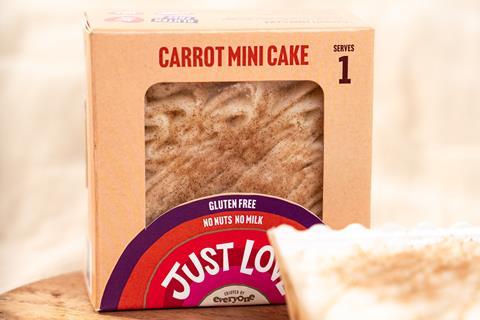
But Woods at Just Love thinks the “huge pull” for egg-free vegan products she witnessed between 2019 and 2023 now seems to be slowing down, with milk free becoming a prominent claim. “Nut free is an important claim when you’re speaking to the healthcare and education sectors, however, gluten free seems to be where the growth is coming from as a whole, specifically gluten free versions of ‘everyday favourites’,” she adds.
Earlier this month, Just Love completely removed soya from its site in South Wales. “This has been a huge project for us led by our customers and we’re excited to see it come into fruition,” notes Woods.
Innovation plays
Fresh new free-from cakes have the power to create buzz on social media and ignite mainstream interest in the category again, says Evans at Finsbury. “When free-from shoppers finally get products that feel exciting or inclusive, they’re really vocal about it online because historically they’ve had so few options available to them,” she comments.
But Evans warns the category has relied too heavily on safe flavours like chocolate, lemon and vanilla for too long. “A shift is coming,” she reveals, noting that the NPD team at Finsbury’s Memory Lane Cakes factory in Cardiff is becoming more adventurous in the space.
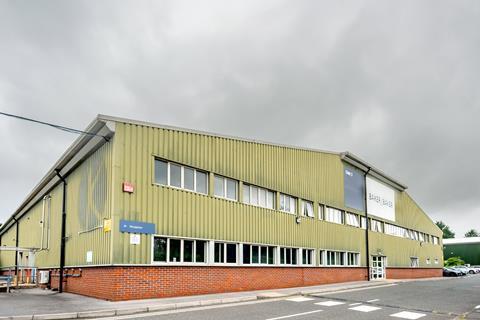
Baker & Baker, meanwhile, has focussed its innovation in free-from cakes on adapting top-sellers from its core range, as well as developing specific products that are exclusive to the category. The manufacturer is also looking to tap into demand for healthier options and cleaner labels, mulling fortification of certain cakes in its free-from portfolio to help boost fibre content whilst reducing the number of ingredients and using more ‘store cupboard-friendly’ ones.
Top launches
We Love Cake is another to have recognised that functionality is beginning to play a more prominent role. Its new Breakfast Muffins proudly display a ‘Source of fibre’ claim along with those for being gluten, wheat, and milk free. These demonstrate how “free from is starting to intersect with broader health trends, including fibre intake and more purposeful snacking,” says Boydell-Smith.
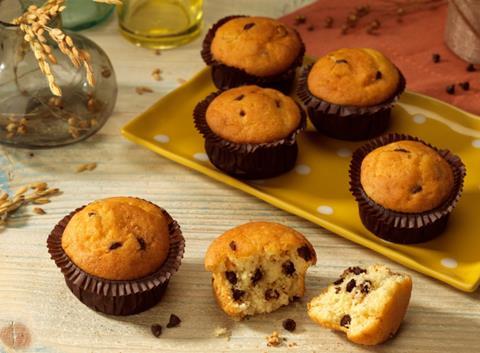
European gluten-free powerhouse Dr Schär entered the UK free-from cake market in 2024 and has since unveiled multiple successful new branded products including Marble Cake and Madeleines. A recent standout has been its Chocolate Chip Muffins, Tesco’s biggest ambient gluten-free NPD of 2025 in value sales and shifting 400,000 five-packs over the past year [Circana data, 52w/e 5 May 2026].
The muffins do not contain any artificial preservatives, use only eggs from barn-raised hens, and have also benefited from Dr Schär’s commitment to sugar reduction. “They have also been a welcome innovation for retailers, reducing waste by offering a longer shelf life in a category typically challenged by short shelf life and operational complexity,” notes Alicia White, head of marketing at Dr. Schär UK & Ireland.
One of the biggest launches in the free-from cake sector over the past year is the gluten-free Colin the Caterpillar cake at M&S. It was said to have been the most requested food item across the retailer’s social media channels, taking months to perfect the recipe in collaboration with long-time supplier Park Cakes in Oldham.
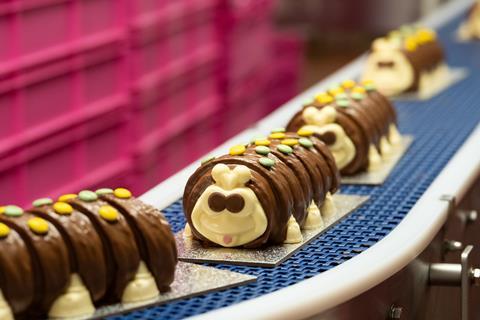
The new Colin even required its own “factory within a factory” – a purpose built, fully enclosed and segregated production line inside the existing bakery – and went on to surpass sales expectations with over 10,000 shifted in the first five days of rollout.
Opportunities knock
Despite the advances made in the free-from cake market, there are still areas that feel undeveloped and hence present opportunities.
Kids products is one of them, says Finsbury’s Evans. “More children are being diagnosed with coeliac disease much earlier now, but there aren’t many fun or licensed gluten-free cake options aimed at them, especially around birthdays and celebrations,” she asserts.
Individually packed free-from cakes suitable for lunchboxes are also of increasing importance, highlights White at Dr. Schär, who says “the out of home offer does not yet match the breadth and accessibility of the mainstream category”.
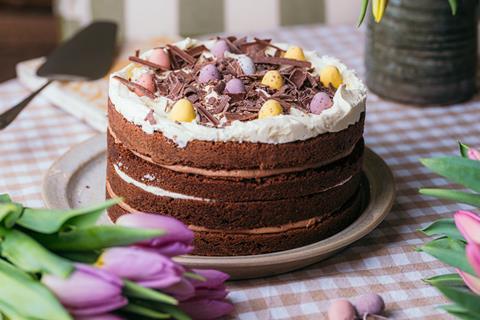
Free-from cakes may perform well at Christmas, when festive celebrations need in be inclusive of all members of the family, but there’s other seasonal occasions that are ripe for innovation. Easter is one these, notes Evans, who says it “still feels quite forgotten outside of hot cross buns”. Helping buck this trend is the likes of Norfolk-based online brand Sponge, which unveiled a new Four Layer Mini Eggs Cake in the spring that is also available in gluten-free and vegan versions.
For bakers and suppliers alike, the renewed momentum in free-from cake signals a category ready to scale and support dynamic sales growth.


No comments yet