


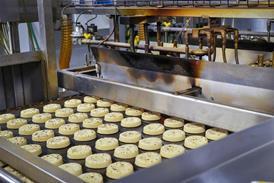










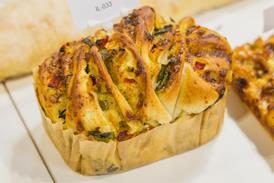

Demand for nutritional and sustainability claims in bakery has led Silvery Tweed Cereals to launch a new range of pulse-based ingredients.
Among the new products introduced by the Northumberland-based cereal processor are flours made from fava beans, chickpeas and haricot beans, as well as kibbled red lentils and fava bean flakes. All ingredients can help boost the protein and fibre content of baked goods.
Pulse flours can be added to bakery products such as breads, tortillas, and flatbreads as a partial replacement for wheat flour. Fava bean flakes can add texture and a nutty flavour to breads, biscuits, and more. And kibbled red lentils are suitable for bakery applications where standard split lentils are too large such as breads.
Analysis conducted by Silvery Tweed found that a 10% addition of chickpea flour to a bakery formulation afforded an increase of 1.8% in protein and 1.1% in fibre. Better results came from haricot bean flour, which bumped up protein by 1.9% and fibre by 1.8% when adding the same ratio.
With over a quarter of fava bean flakes made up of protein, they give the biggest protein lift – up 2.9% when using a 10% addition to the recipe (although fibre rose by only 0.9%). Silvery Tweed also referred to McCance and Widdowson’s nutritional data for red lentils, which has them comprised of 23.8% protein and 4.9%. This translates into 2.4% protein and 0.5% fibre enhancement off a 10% addition to the mix.
“Pulses are healthy and nutritious, and they’re gaining popularity as people become more familiar with them as natural sources of protein and fibre,” commented Julie Telfer, NPD manager at Silvery Tweed. “They can be used as a main ingredient or as a substitute ingredient in cooking and baking, and they are also a natural source of magnesium.”
Telfer noted that pulses have broader environmental benefits too. “They use less water in the growing process than traditional crops and remove carbon dioxide from the air, often making them carbon negative. They also absorb and recycle other toxins,” she added.
Legume crops such as beans and lupins are particularly efficient in storing chemical energy because they fix atmospheric nitrogen and may capture more sunlight over the day than cereals.
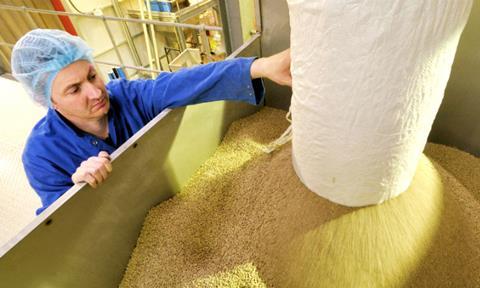
While red lentils, chickpeas and haricot beans are not commercially available in the UK – imported instead from Turkey, Canada, and France – Silvery Tweed sources fava beans from farms within a 50-mile radius. Prior to being milled or flaked at its factory in Berwick-upon-Tweed, the fava bean kernels are cleaned and de-hulled at the Pulse Processing site 20 miles away in Belford.
Pulse Processing has estimated that producing one tonne of spring fava beans requires a total of 1,576.2 MJ of energy. This covers cultivation, harvest, transport, and processing, with most of this energy (1,445 MJ) used during on-farm growing operations, assuming a yield of 4.5 tonnes per hectare. Processing represents only a small proportion at 25.2 MJ per tonne.
Silvery Tweed is a family-owned business specialising in premium cereal and seed ingredients, which it supplies to the bakery and breakfast cereal sectors. It employs over 70 people, cleaning and processing grain from growers based largely in the Borders area, as well as from its own farm on the northeast coast.












No comments yet