













The founder of Hawkens Gingerbread is on a sustainability mission to prove the commercial viability of growing spices in the UK for use in bakery.
Alastair Hawken was originally inspired to create his Lincolnshire-based brand after discovering that Grantham Gingerbread, said to be England’s oldest biscuit recipe (dating back to 1740), had vanished from production around the turn of the millennium.
Despite having no background in baking or food manufacturing, Hawken’s desire to revive the piece of culinary heritage lead him to trading in his 20-year career in TV broadcasting in 2009 and establishing his business inside a repurposed Salvation Army citadel in Grantham.
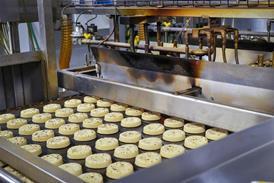
Hawkens now produces a range of biscuits including traditional gingerbread men and gingernuts as well as flavoured varieties like Italian lemon and chocolate orange. These are sold via its website and retailer Selfridges, and supplied to National Trust sites, farm shops, garden centres, and visitor attractions nationwide.
Setting up roots
The UK spices and culinary herb market is predicted to jump nearly 13% this year to reach £35.8m in revenue [Statista data], with the vast majority of these ingredients imported from overseas. A total of 26,784 tonnes of ginger was imported to the UK in 2023, mainly from China along with Peru, Brazil, Nigeria, and India [World Integrated Trade Solution].
Driven by a goal to become the UK’s most sustainable gingerbread producer, Hawken began looking into setting up the first commercial ginger growing operation on British soil three years ago. This would help unlock significant carbon reduction associated with transportation as well as creating new jobs and bolstering food security at a time when weather-related supply chain disruption is on the rise.
However, due to poor soil and weather conditions here – ginger is a root that thrives in warm regions with rich, tropical earth – Hawken was forced to find an alternate method. “The concept was straightforward; execution was anything but,” he revealed.
“The breakthrough came when I attended the government-funded Help to Grow: Management Course at Nottingham Trent University’s Business School. Stepping back from day-to-day operations gave me the much-needed space to explore diversification and routes to sustainability seriously,” added Hawken.
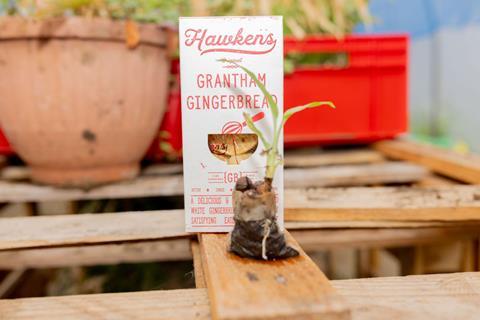
He settled upon using hydroponics to grow ginger inside a polytunnel he’d secured in Grantham. But with the import of live plants prohibited by customs, he still had to source planting stock in the UK. Fortunately, he found a nurseryman in East Sussex with eight plants of Zingiber officinale – food-grade ginger variety – which he was able to purchase. To scale up, he micro-propagated the precious stock via a lab process called tissue culture.
With the help of a local plumber, Hawken developed a pipe-based hydroponics system for ginger growing involving periodic flooding of the plants with a nutrient-rich solution. They are drained completely each time to oxygenate the roots.
The polytunnel mimics tropical warmth, maintaining temperatures between 25°C and 30°C and high humidity (85%). “Many assume the UK is too cold for ginger,” said Hawken. “In reality, the natural growing season of ginger (April to Nov/Dec) aligns well with our seasons. The bigger issue was actually that it can get too hot. Ginger is traditionally an undercrop, thriving in humid, relatively cool shade – conditions we carefully replicate inside the polytunnel.”
First established earlier this year, the ginger plants are now flourishing in Grantham.
“The immediate goal is to use our UK-grown ginger in Hawkens Gingerbread by year-end. This will mark a historic first – a domestically-produced gingerbread,” expressed Hawken.

Beyond ginger
Should Hawken’s model prove successful with his ginger crop this year, he intends to leverage the methodology for other spices. Turmeric, a fellow rhizome from the same botanical family, is a probable next step.
Hawken is also collaborating with flavour profiling experts to systematically identify UK-native plants that match common spice profiles. “Take wood aven (or herb bennet). Currently overlooked, its root contains eugenol – the very compound that gives cloves their distinctive heat. We’re already cultivating it in our polytunnel,” he said.
Among the 50 to 60 native species expected to be capable of replicating exotic flavours are magnolia leaves, which can mimic cinnamon, and cow parsley seeds, which carry notes of orange and cardamom.
“It’s likely we lost a lot of this knowledge as global trade flooded Britain with spices centuries ago and our ancestors stopped using these local flavour enhancing ingredients. So, we’re embarking on a rediscovery of lost knowledge,” declared Hawken.
The biscuit maker noted that, “as leaders in the baking sector, we’re all so busy spinning plates, but taking the time to network with experts and fellow business leaders is invaluable”. The external perspective and knowledge he gained from attending the Help to Grow: Management Course, for example, gave him the courage to take on the established spice imports market, he said.
Hawken asserted that his ultimate success metric would be creating a hyper-local, self-sufficient supply chain in Lincolnshire, producing a range of entirely British-made products infused with homegrown spices and native flavour profiles – all destined for global shelves. “I’m certain it’s possible,” he concluded.












No comments yet