









Artificial intelligence may not have the hands-on capabilities to help artisan and craft bakers with their small-batch production, at least for now.
But just as large-scale manufacturers are using AI to improve efficiency at factories, some smaller bakery firms are finding ways to leverage its computational power to help develop new tech to support operations and growth. By doing so, its helping them save a considerable amount of time and money.
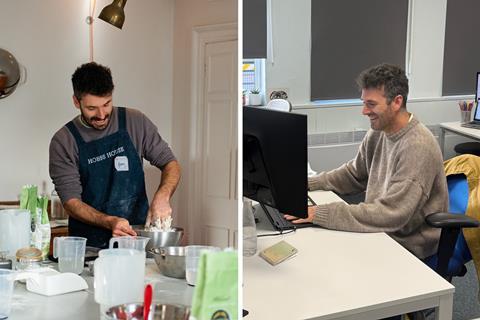
Hobbs House Bakery sales director Henry Herbert has spent the past five months using AI to build bespoke software for the Gloucestershire-based business.
“We’ve had the basics, but things like a proper CRM, dashboards, production planning or paperless picking for our drivers have always felt out of reach,” commented Herbert. “When we looked at off-the-shelf systems, they were expensive, never quite fitted how a bakery works, and we were never sure we’d see the value.”
Instead, he decided to ask AI to help create some digital tools, starting with a simple business case planner that could track and send emails and give status updates. With this adopted quickly, Herbert saw many other areas where tailor-made tools could help fix specific problems.
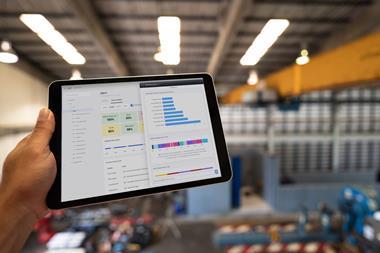
So far these include a CRM system to track their sale pipeline, dashboards to give clear visuals on the bakery’s data, as well as invoicing tools and industry trends monitoring. More than 20 new software solutions have currently been adopted, with more getting added.
He used a mix of AI assistants including Claude (made by Anthropic, which recently had the largest IPO in history), OpenAI Codex, Grok, and Kimi. Each does a different job, noted Herbert, and they review each other’s work meaning one might build a feature whilst another checks the code, looks for mistakes, or runs security reviews.
Herbert is also one half of Channel 4’s The Fabulous Baker Brothers, and admitted he had no real technical background other than baking and running sales. Rather it was his curiosity, patience and willingness to learn that allowed him to get the software created.
“The barrier has come right down,” he told British Baker. “The biggest challenge isn’t technical, it’s adoption: taking your people with you. A tool is only useful if the team actually uses it, so I build with staff, listen to their feedback and keep improving things around how they really work.”
But with stories of hacking and cybercrimes rife in the media, Herbert highlighted the need to take security seriously. “Protecting our data matters more than anything else,” he asserted. “If a tool breaks, we can rebuild it, but our customer and business data has to stay safe.”
Hobbs House Bakery apps are self-hosted and secure, all linked through one central database it controls, with staff only seeing what it relevant to their role. “We run regular AI security reviews, test changes on a copy of our data before they go live, and track every change so it can be rolled back,” confirmed Herbert.
He estimates the company has saved thousands on new systems and annual software subscription fees. “We own the software outright and have full control over it,” he said. “For me, though, the real value is in what we can do as a business with tools built exactly for us.
“I don’t see this slowing down and I want to make sure I am keeping my bakery as relevant and competitive as possible,” added Herbert.
A fresh batch
Over in Buckinghamshire, David Biley saw how his wife’s cake shed business was requiring as much time on paperwork as it was on baking. As it was just a solo operation out of their home in Wingrave, he couldn’t find a suitably affordable digital solution.
Biley wasn’t a dedicated software engineer, but had been working in the IT sector for many years, and put AI coding tools like Claude and Cursor to the task of developing software that took care of the allergen labelling and batch records for small food businesses including micro-bakeries.
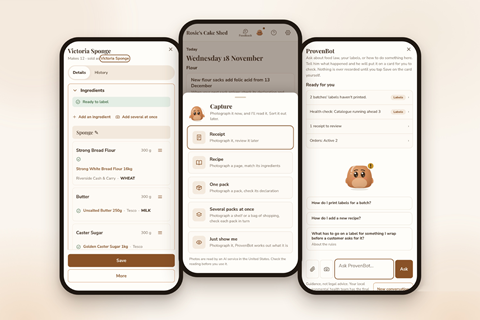
His app, called ProvenBatch, was unveiled for pre-launch beta testing last month. It allows users to take photos of ingredients decks from supplied products they use in their recipes, which highlights any of the UK’s 14 major allergens for review. It carries these details forward into batch logs and can help produce Prepacked for Direct Sale (PPDS) labels that align with Natasha’s Law regarding on-pack emphasis on allergens.
“Because each one is tied to a batch, a maker can answer ‘What was in this?’ straight away if a customer or Environmental Health officer asks,” noted Biley. “The producer remains responsible for what leaves the kitchen; the system makes the correct information simpler to capture and harder to miss.”
Interested businesses are currently offered a free 30-trial of the ProvenBatch software, which can be accessed here. There are also a limited number of beta trials available to vetted UK food firms to help shape the app’s development with feedback.
Note: the above AI tools all have free tiers but are restricted compared to paid plans and have limits on usage and features.



No comments yet