










Bakery manufacturers may be able to achieve the perfect product at scale, but productivity is a different matter.
While it’s unrealistic to ever expect 100% efficiency, it’s always a valuable pursuit to try to convert as much theoretical production capacity as possible into sellable output.
Missed bakery capacity is rarely caused by just one major failure. More often, production efficiency is gradually diluted through a mix of operational deviations.
This can include changeovers taking longer than planned, microstops (temporary interruptions) that are never properly categorised and resolved, or lines running below their intended speed. Additionally, weight buffers can slowly increase ingredient consumption, reintroducing leftover dough to the process can disrupt product stability upstream, and inconsistent cleaning routines can result in unpredictable production conditions leading to energy drift inside utility bills.
On an individual basis, these losses may appear manageable. But added together across an entire operation, they become what is known as the Hidden Factory – essentially the difference between what a bakery line was engineered to produce and what it actually delivers.
According to a peer-reviewed study referenced in AMF Bakery System’s Industrial Bakery Performance Guide 2026, losses reported from baking and confectionery operations fall between 9.7% and 14.4%. For bread production specifically, they range from 10.4% to 13.4%.
“Performance losses often occur when quality deviations are not detected quickly enough,” warns Ronald Hoiting, head of marketing UK & Ireland at equipment supplier Rademaker. “Traditional quality control methods rely on periodic sampling, which means defects can remain unnoticed for some time. This can lead to product waste, rework and reduced production efficiency.”
So, how are these inefficiencies being calculated at UK bakery manufacturers? How is AI-powered data analysis helping, and what are the solutions available? Let’s take a closer look.
Measure for measure
Bakeries may be keen to invest in capacity-boosting technology, but it’s wise to first get an accurate picture of current line performance.
This can be done by establishing baselines in key metrics, including the following listed by the AMF report:
- Overall Equipment Effectiveness (OEE) per line and per SKU
- Give-away percentage
- First-pass yield
- Changeover time
- Energy use per kilogram
- Dough rework ratio.
As the standard manufacturing metric, OEE combines availability, performance, and quality into a single indicator, given as a percentage.
In this case, availability is the percentage of scheduled time that the operation is actually running; performance measures how fast the machine runs compared to its ideal speed (accounting for microstops); while quality is the ratio of units meeting quality standards versus the total volume (on the first pass, including scrap and rework).
This year’s AMF report puts the average OEE in food manufacturing to be 53% – in other words, nearly half of theoretical capacity is structurally unavailable.
Walter Olivero, sales manager at bakery management systems provider Oripan, says the OEE figure is useful but it does not always tell the whole story.
“If a line achieves 75% OEE, what is causing the remaining 25% loss?” he asks. “Is the equipment breaking down, are changeovers taking too long, or is the line repeatedly stopping for a few seconds at a time? Is production being held back by one machine, or is the problem somewhere else in the process?”
Without clear answers, warns Olivero, teams can spend valuable time addressing the symptoms rather than the causes.
Each of the three components to OEE need their own focus to get right, asserts Finsbury Food Group business transformation director Adrian Greenlay.
“Part of the complexity, and the opportunity, is that OEE is influenced by far more than the manufacturing operation alone,” he says. “Planning, engineering, technical and supply chain teams all play a part. The value comes from breaking the measure down, making sure every team understands its contribution and improving from there.”
A rigorous loss and waste analysis is said to be the foundation of the Finsbury One Excellence Programme, which has helped address the range of operational maturity across its eight UK manufacturing sites.

“For a speciality bakery business like ours, the defining challenge is balancing a broad product portfolio with the short shelf life of fresh products,” notes Greenlay. “That puts changeovers at the heart of performance, and it makes them one of our biggest opportunities. It’s an area where we focus a lot of our improvement efforts.”
This breadth of offering may be a strength, according to Greenlay, but it requires a disciplined approach that works category by category, line by line, and product by product. Measures that are linked directly to business performance are chosen to drive consistent, incremental improvements, he adds.
Smart surveillance
Inspection and sensor equipment are getting smarter in their support of real-time monitoring of line stoppages, production progress, and equipment condition.
These technologies allow bakery firms to identify bottlenecks, understand recurring issues, and make more informed decisions about performance improvement.
For example, Rademaker entered into a strategic partnership last year with Italian vision inspection specialist Sensure, which leverages AI in providing sophisticated systems to check attributes such as shape, size, colour, structure and topping distribution.
Elsewhere, advances in electromagnetic force restoration, signal processing, and vibration compensation allow increasingly precise weight measurements, even at high production speeds. Bakeries can use them to reduce overfilling and giveaway, while maintaining compliance with net weight regulations.
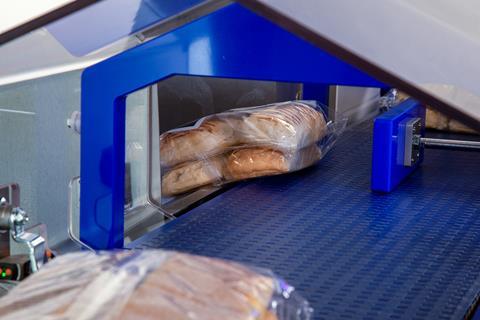
The same principle applies to product rejection. says Sam Reynolds, account manager at weighing and inspection equipment specialist Mettler Toledo.
“A bakery might be producing an excellent product, but if its inspection equipment cannot reliably distinguish between genuine contamination and natural variations in ingredients, perfectly acceptable products may be discarded,” he adds.
Baked goods with different densities, moisture levels and complex ingredients combinations present a particular challenge, but recent advances in metal detection and x-ray machines are helping manufacturers improve their detection accuracy and cut down on false rejects, Reynolds says, highlighting the range of benefits to sustainability as well.

And then there’s the complexity of frozen bakery manufacturing to consider. Only by gathering detailed temperature data at all points – including the oven, freezer, and cold store – can help suppliers pinpoint the causes and locations of performance loss.
Temperature data logging specialist Signatrol has a capable solution in its food-safe dLog SL63T unit, which can measure from -40°C to +125°C with an accuracy of ±0.2°C. “This means a single data logger can potentially follow a product through the full thermal journey, from the initial cooking process, through freezing and cold storage, and ultimately through the final reheating or cooking process,” says Signatrol operations director Martin Westover.
Data day operations
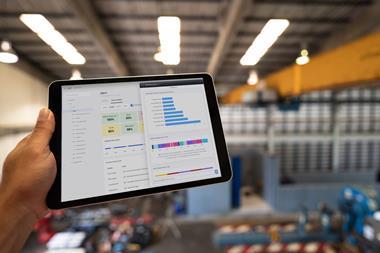
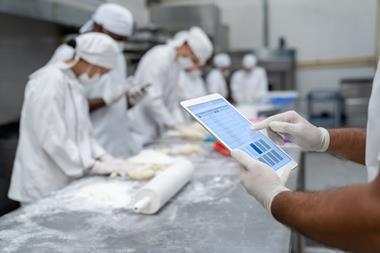
The wealth of sensors utilised at modern bakeries generate a sizeable chunk of production data, which can be plugged into an AI-powered system to identify patterns humans might struggle to spot.
In turn, this not only helps understand what happened during a shift, but why it happened.
“Faster identification of issues helps reduce downtime, while better understanding of production patterns can improve changeover efficiency, reduce waste, and optimise labour deployment,” says Paul Johnson, sales manager at equipment supplier Fritsch UK.
Cloud-connected, integrated digitalised platforms, such as Fritsch Smart Production Insights and Oripan Factory System, can help bakery manufacturers see how the different parts of production relate to one another.
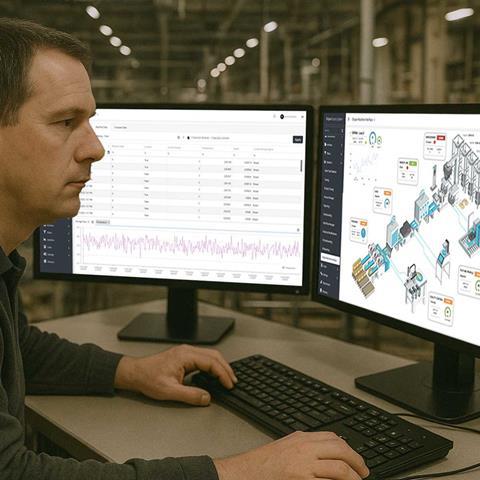
“The aim is not to give bakers more screens to watch,” says Olivero at Oripan, “It is to give them better answers, so they can spend less time searching for information and more time improving production.”
The AMF report concludes that the strongest bakeries in 2026 will not necessarily be those with the most product ideas or the highest installed speed. They will be the bakeries that understand where performance is being diluted, quantify the gaps, and systematically remove variability from the process.
Growth increases complexity, it notes, adding that structured control converts that complexity into capacity, consistency, and margin.
AI-driven optimisation can also support a move from reactive problem-solving to continuous improvement and predictive maintenance, comments Johnson at Fritsch, creating a “more efficient and resilient bakery operation for the future”.
ADVERTISEMENT: SIGEP WORLD
Discover the Future of Foodservice at SIGEP World
From 23–27 January 2027, SIGEP World returns to Rimini, Italy, bringing together professionals, leading brands and innovators from across the global foodservice industry.
Explore five key sectors – Gelato, Pastry, Bakery, Coffee and Pizza – and discover the latest trends, technologies and solutions shaping the future of the industry.
From innovative products and equipment to new business models and emerging market opportunities, SIGEP World is where inspiration turns into real business connections.
Meet international industry leaders, expand your professional network and discover new opportunities to grow your business.
Five sectors. One global meeting place. Endless opportunities. Join the international foodservice community at SIGEP World 2027.







No comments yet