












The University of Huddersfield is embarking on a collaborative project with bakery ingredients supplier Puratos to create new fibre-rich bread formulations.
The three-year Knowledge Transfer Partnership (KTP) sees university professor Grant Campbell use an experimental modelling approach he has developed to provide insights into the effects of dietary fibres in bread.
Professor Campbell’s mathematical models enable the combined effects of ingredients to be better predicted, and therefore making it easier to formulate bread mixes that deliver targeted functionality. The new approach will be adopted by Puratos, allowing it to design complex bread improvers faster and more effectively using a broader range of natural fibre ingredients.
“Eating more dietary fibre is the best thing most of us could do to improve our health, but fibre tends to damage the structure and palatability of bread,” commented Campbell, who is part of the university’s Department of Physical and Life Sciences, and director of its Biorefinery Engineering and Bioprocessing Research Centre.
“This project will help Puratos create bread formulations that deliver the health benefits of fibre while maintaining the quality and appeal of breads,” he added.
Numerous functional ingredients are included in bread improver formulations and finding the right combinations and levels relies on labour-intensive baking trials. The KTP aims to speed up these trials by quantifying the functional properties of natural dietary fibres and predicting how their combinations will affect the breadmaking process and bread quality.
Using an instrumented dough mixer that measures evolving dough texture during simulated mixing, heating, and cooling, Campbell’s models will be able to distinguish the separate effects of flour, water, and fibres on different aspects of bread quality. The models will then be used to identify combinations of fibre ingredients with complementary and synergistic behaviours to deliver higher quality and healthier breads.
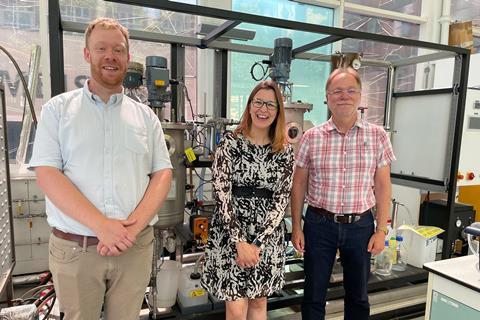
KTPs are government-funded programmes aimed at helping UK businesses improve competitiveness, production and performance, with match-funding through national innovation agency Innovate UK. Each programme involves a collaboration between an organisation, a university, and a graduate associate who is funded for the duration of the project
Dr Liam Morris, who previously worked for Nestlé as a PhD Student based out of the University of Leeds and then as a bakery and lipid scientist for research and product development firm Campden BRI, has been appointed as the KTP associate to work alongside professor Campbell and his team.
The University of Huddersfield currently has a portfolio of around 25 KTPs attracting a total of almost £6m in funding.
Belgium-headquartered Puratos supplies bakery solutions to manufacturers in over 100 countries worldwide. Among its range are bakery mixes, sourdough starters, bread improvers, fillings, inclusions, fats, egg wash alternatives, grains and seeds, as well as patisserie and chocolate ingredients.
“Puratos is driven by the principle of ‘Food Innovation for Good’, with a focus on developing food solutions that support health and well-being globally,” said Céline Laigle, who has been bakery R&D manager at Puratos’ UK base in Buckingham for nearly 15 years.











No comments yet