



With ongoing labour shortages and rising wage costs, automation is no longer a nice to have for many bakeries instead becoming an essential part of daily operations.
But some remain wary of the move to robotic counterparts fearing it will deskill existing and future workforces, and result in lower quality baked goods for consumers.
So, in a sector under increased pressure to do more with less, are the robots friend or foe? And what can we task our automated counterparts with to maintain (or even improve) speed, safety, consistency, and sustainability of operations while ensuring top notch products?
“Automation is increasingly becoming a strategic investment for bakeries of all sizes”
David Moore, ESG director for The Compleat Food Group, is firmly on the side of automation, noting that when used correctly it can do much more than boost the brand’s bottom line.
“Automation is increasingly becoming a strategic investment for bakeries of all sizes,” he says. “Not just to boost speed, but to solve practical challenges around labour, consistency and sustainability. From smaller investments like smart mixers to more advanced robotic automation systems, the sector is seeing a shift toward technologies that do more than just streamline production.”
A well packaged solution
For example, automation has improved sustainability at the brand’s Tottle Bakery site in Nottingham by enabling the removal of plastic trays from pork pie packaging. This has eliminated 110 tonnes of plastic and cut The Compleat Food Group’s annual CO2 emissions by 430 tonnes, Moore says.
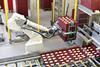
To achieve this meant tackling a tough practical problem head on – how to take a core production element out of the overall process without sacrificing speed or efficiency. “The plastic trays played a key role in stabilising pork pies during high-speed flow wrapping, and without them the line efficiency would have dropped by 30%,” says Moore. “To solve this, we invested in robotic automation that picks and positions pies with precision and speed, allowing them to move seamlessly through the wrapper without trays. The automation not only maintained throughput but improved consistency, and did not compromise product quality, safety or shelf life.”

Fellow manufacturer Proper Cornish has also invested in pick and place robots to more efficiently package its finished products into cardboard cases.
“[This] allows us to have greater control on piece count accuracy (with some cases containing up to 100 units),” says managing director Paul Saunders.
“The robotic packing system also allows us to automatically ‘grade’ each unit prior to packing and it allows us, on the higher speed products, to have a reduced headcount within our packing department, which results in a lower unit cost for manufacturing.”
Evolving bakery roles
Reducing costs by increasing efficiency sounds like a good plan but yet some bakery workers might be concerned about Saunders’ last point as one of the main worries about embracing automation is that it will put people out of jobs. But this doesn’t have to be the case.
At Proper Cornish, for example, automation means roles are evolving, not being erased.

“The robot allows us to have a fixed and static crew,” says Saunders. “The team members’ roles have changed from active packers to setting up, monitoring and managing the robotic activity. This change has resulted in an upskilling of the workforce, while reducing manual handling and repetitive movements.”
Mikkel Viager, principal advisor at automation platform HowToRobot, agrees that worries are unfounded. Right now, the reality is that the UK baking industry needs skilled staff to grow meaning while workers’ roles may change to embrace new technology they won’t disappear completely.
“What automation can do is enable companies to offset and relocate resources they already have to areas where they can add much more value,” he says. “For a while people have talked about robots coming in and taking people’s jobs – but we just haven’t seen that happen.”
“Automation is transforming bakery teams”
Viager highlights that staff often have a deep knowledge of their craft, something automation should aim to enhance. This becomes more feasible as the technology improves.
One vision for the future is that workers will increasingly look after the machines.
“Automation is transforming bakery teams,” says Vita Whittaker, CEO of catering and bakery equipment supplier WhitCo. “Instead of manually managing multiple ovens or juggling bake cycles, staff now oversee pre-programmed systems that ensure accuracy and quality every time.”
WhitCo is the UK partner for Debag ovens, a brand that provides automated baking and intelligent control systems to simplify complex processes.
Like Saunders, WhitCo maintains that this newer role features less lifting, bending and repetitive movements than traditional bakery jobs, which could help workers’ wellbeing.
Technology such as this could also support front-of-house staff in hospitality-led bakery locations.
For example, Jestic Foodservice Solutions is already deploying Bear Robotics’ Servi+ service robot in its test kitchens. The Servi+ promises to be adept at navigating ramps while carrying up to 16 different dishes at a time.

“We all know staff retention has been a challenge since long before Covid-19 – and unfortunately, little has changed,” says Kevin Garry, commercial director at Bear Robotics EMEA.
“What we’ve found is that staff enjoy the human side of their work: the face-to-face interactions, the opportunity to engage with guests, and the chance to bring their personality to the job. It’s the repetitive, mundane tasks – clearing dishes, unloading supplies, endless trips back and forth – that drain morale.”
Overcoming challenges
On paper, the case for bakery automation looks straightforward. After all, robots don’t get tired, grow bored or come in hungover for a Saturday shift. But for all the projected benefits, inviting in the robots definitely isn’t a magic bullet for everyone.
For one thing, tech tends to be expensive, so the upfront investment can be brutal. Many bakery sectors already work on wafer thin margins – and the wait to realise robot-driven benefits might just be too long to justify.
Plus, bakeries aren’t mass-producing anonymous widgets that require a one-size-fits-all solution. This presents the sector with some unique challenges.
“The [automation] process can be most difficult to refine when the product varies in shape and size, like pork pies, which naturally vary due to the way they’re manufactured,” says Compleat’s Moore. “The pie variation can make consistent packaging more complex, requiring longer trials.”

Saunders from Proper Cornish believes that automation can be easier to implement when all that’s required is a standard process for a standard product. Yet bakery isn’t always that straightforward.
“In the bakery world we see a lot of variation due to temperature, seasonal raw materials, and process controls,” he says. “This results in a much wider and less consistent unit being presented to the automation solution. Automation in the bakery industry therefore needs to be intelligent and able to offer the ability to adapt to these product variations. Depending on the bakery sector, with the vast range of SKUs some bakers are manufacturing means that an automation solution is too complex or cannot offer sufficient flexibility.”
“If you go technology first and application second, you’re taking a big risk”
In fact, many shoppers actively value this variation and are put off by finished products that feel too industrially polished. Saunders says that this is a particular problem for brands with artisanal-style lines that need to appear as handmade as possible. This means there are areas of business that he’d never consider setting the robots to work on, “such as on the production assembly lines where our handmade products are produced”.
Another challenge for successful automation is what Viager from HowToRobot calls the “shiny new toy syndrome” – getting drawn to impressive technology that doesn’t fit your needs.
“It’s easy to fall in love with technology and automate for the sake of the tech,” he says.
“You might see something at a competitor’s plant, or a trade fair, and think it would work for you too. But if your production flow or product mix is different, the same solution might not be the best choice. If you go technology first and application second, you’re taking a big risk.”
Free webinar: how is AI and technology changing the baking industry?
Experts from the BakeTran, Gail’s, and Made Smarter will be revealing how latest tech developments are enhancing operations across the bakery sector as part of a free webinar hosted by British Baker.
The webinar, supported by Aiperia and TraceGains, is titled ‘How are AI and technology changing the baking industry?’ and will take place at midday on Tuesday 30 September.
“The key is to start with your real challenges and then look for the right technology to solve them. We often see this approach leading to simpler solutions that are a better fit for the bakery,” he adds.
Viager points to some practical ways to do this. One is to involve operators, who often know which tasks are most repetitive or physically straining. Those can be good candidates to evaluate for automation. The next step is matching those ideas with what’s technically and economically feasible – something not every bakery has the time or resources to do internally.
According to Viager, many of the core production steps in bakeries are already automated, so there are typically fewer gains from upgrading those compared to automating complementary processes around production. Low-hanging fruit often includes end-of-line packaging, palletizing, product and material handling tasks.
“Once you have those bottlenecks or challenges identified, that’s when you can go out and find a matching solution and capable technology from the right supplier,” he says.
Despite the risks of getting automation wrong, the rewards can be huge for bakeries.
Ultimately, making automation work is about more than finding the right tech and plugging it in.
Bakery floor staff need to be fully onboard with the change while understanding that it could be their passport to more rewarding roles one step removed from the production line. And senior staff must keep their eye on optimising processes, being realistic about opportunities and properly trialling new systems.
As Moore attests: “With the right technology and teamwork, large-scale sustainability improvements are not only achievable, but they’re commercially viable too.”


No comments yet