










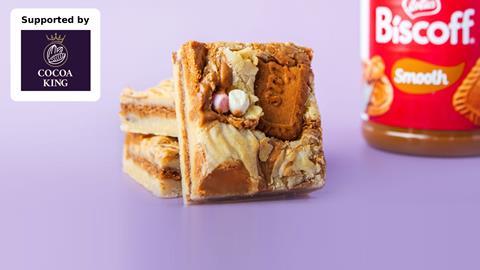
Biscoff, Nutella, Marmite, and even Guinness are all lending their star power to bakery products as consumers seek comforting, familiar flavours and quality reassurance at every turn.
The trend isn’t exactly new, but it certainly seems more prevalent of late – it’s unusual to see a sweet bakery range without the caramelised biscuit or chocolate hazelnut spread nestled among its ranks. And increasingly, recognisable names from outside bakery are dipping a toe, with confectionery brand Swizzels among those to ramp up its presence with biscuits and cheesecakes recent innovations thanks to licensing deals with the English Cheesecake Company and Baleigh.
“That kind of recognition is incredibly powerful”
So, what power do branded ingredients have over bakery consumers that baked goods alone can’t capture? Which brands are making a grab for the spotlight? And, what’s the right way to go about things, legally speaking, to ensure a sweet outcome for all involved?
“Brand recognition adds value beyond the product itself,” explains Finsbury Food Group brand manager Calum Clark. This can encourage consumers to trade up particularly if there’s a stronger premium perception around some brands, especially those positioned in more indulgent spaces.
By removing the uncertainty from purchase decisions, they can help play a critical role in creating impulse sales as well as driving demand for repeat purchases and all-year-round distribution.
A brief history of the star duo
There’s no denying that Biscoff and Nutella are the go-to brands in sweet bakery toppings and fillings, with their scale of distribution and longevity in the market cementing this status.
“They’ve spent decades building consumer trust, so people know exactly what to expect from them,” adds Clark. “That kind of recognition is incredibly powerful.”
Biscoff is a portmanteau of the words biscuit and coffee, and is produced by Lotus Bakeries, the company founded by Jan Boone Snr in 1932. The Belgian baker developed Biscoff from speculoos, a cinnamon-forward caramelised biscuit recipe that was created after the Dutch East India Company’s introduced exotic spices to Europe in the 17th century. Since first launching to the wider market in 1954, Biscoff has proved a global hit. It is now made at 13 sites across the world and bought by 7.4m UK households [Nielsen data, 52 w/e 27 December 2025].
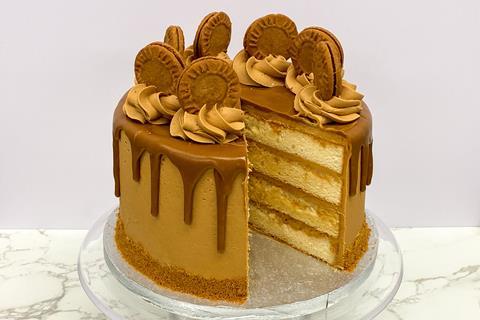
The roll out of Biscoff Spread in 2008 opened new doors as a bakery ingredient and was later adapted into a topping sauce available in squeezy bottles for quick application. Lotus maintains official ‘Created With’ partnerships with bakery businesses, allowing them to legally use the trademarked Biscoff brand in their products.
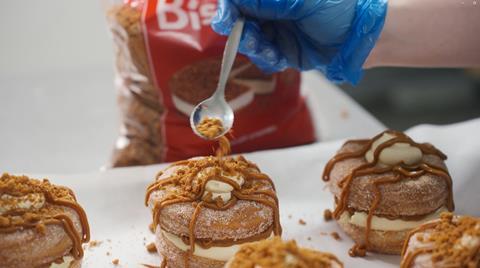
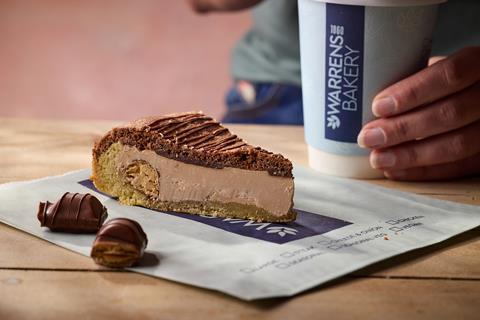
Among the notable innovation collaborations are Krispy Kreme’s Biscoff doughnut range – already 11 years old – as well as the more recent Biscoff Sonut (cronut) at Soho Coffee, Biscoff Cookie Pie at Warrens Bakery, and Big Biscoff Cake at pub group Farmhouse Inn.
“The prominence of Biscoff and the community around the brand, encourages customers to share Biscoff inspired products with their fellow Biscoff lovers, helping bakeries increase visibility and sales,” says Joanna Agnew, marketing director at Lotus Bakeries UK.
Nutella, meanwhile, was originally developed by Italian baker Pietro Ferrero as a creamy, spreadable version of hazelnut chocolate blend gianduja – his son Michele and Francesco Rivella revamped the recipe and established the brand name in 1964. Petro’s grandson Giovanni currently runs the Ferrero company, which hit UK revenues of £663.6m in its latest financial year (to 31 August 2025).
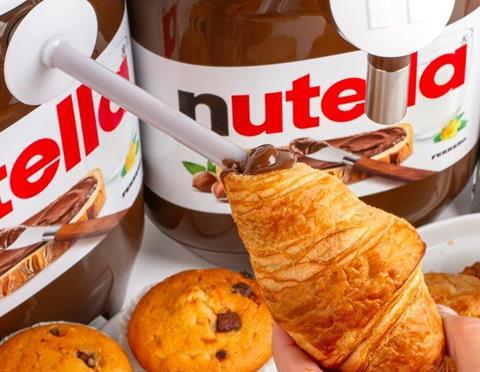
Like Lotus, Ferrero offers official collabs with UK bakery brands such as Cake Box which created a range of Nutella cakes, cupcakes, and cheesecakes, launched in 2024. The same year, Ferrero’s foodservice division also agreed a deal with equipment supplier Sephra to offer UK operators manual or electronic Nutella dispensers, encouraging more bakery innovation with the spread.
Nutella has continued to crop up in new bakery recipes, among them the Crunch Cake at dessert parlour Haute Dolci and the Luxury Nutella Dome Crunch Cake at patisserie brand Heriots.
Other brands in the mix
Ferrero also has the Kinder Bueno range, which also combines chocolate and hazelnut but with added cream and wafer flavours. The brand remains incredibly popular, particularly with younger audiences and social media driven products – it can be found on the likes of layer cakes, cupcakes, and loaded cookies.
The more grown-up Ferrero Rocher and its coconut & white chocolate cousin Raffaello, meanwhile, present potential for spreads, toppings, and fillings, according to Adam King at ingredients supplier Cocoa King. “Consumers love familiar, indulgent flavours and Ferrero’s strong brand recognition makes it a natural fit for premium bakery products,” he says.
Mondelēz International has its own stable of household chocolate brands including Cadbury, Oreo, and Milka, which appear in sweet bakery treats at UK retailers thanks to a number of successful licensing partnerships with manufacturer Baker & Baker. One of its bestselling innovations in recent years is the Cadbury Mini Eggs Chocolate Cookies, which saw wholesale orders triple this past Easter.
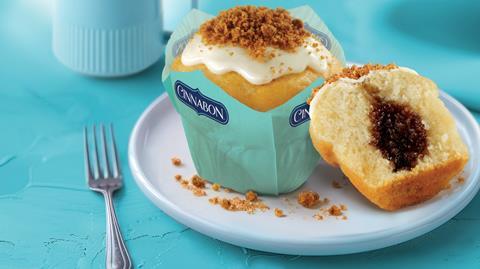
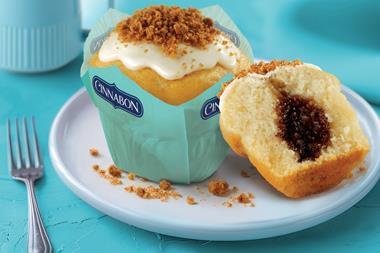
Baker & Baker has also recently enabled American brand Cinnabon to reemerge on the UK market, after all of its franchise shops were closed last September. The new Cinnabon range co-manufactured in the UK features muffins and doughnuts with cinnamon fillings, topped with cream cheese icing, and cinnamon biscuit crumb.
Notably, Cadbury cakes – which includes the Mini Rolls that have been around since the mid-sixties – is a separate and exclusive licencing deal to other Cadbury branded ranges. Premier Foods has held the rights to manufacture Cadbury cakes since 2007, with the new caramel variant of mini rolls named as a notable launch during its most recent financial year to 28 March 2026.
Amidst the swathe of sweet treats, it would be remiss not to mention at least one savoury brand that holds favour with bakers. And there’s arguably no more quintessentially British brand than Marmite, which has transcended toast toppings and into the likes of the Ginsters Steak & Marmite with Cheese Pocket pastry. There’s also an entire range of Marmite inclusive items at M&S including pizza, sausage rolls, pinwheels, and sandwiches – they’ve even put a hint of the branded yeast extract in a Pecan & Salted Caramel Brownie.
Eagle eyes when it comes to legal
Whilst hoping to drive bakery sales through consumer engagement with brands, it’s important to remember that trademarks are protected.
“There are strict rules governing the use of brand names in product marketing,” stresses Jacqui Passmore, marketing lead West EU & AMEAP at Dawn Foods, who warns of legal and licensing issues that may arise from using a trademark without the appropriate permissions.
Suppliers need to ensure the brand owners have given approval prior to products hitting the shelves, often involving a lot of check through the entire development process so that branding is being represented in the right way. Baker & Baker is an example of a manufacturer that welcomes the wholly collaborative manner of NPD brought about through licensing.
Brand owners have “full involvement across a product’s conception, manufacturing, and marketing,” according to Baker & Baker licensing director Michael Bancroft.
Craig Wood, assistant retail director at chain Warrens Bakery, also recognises the substantial benefits from officially licensed partnerships. These include opportunities for joint marketing activity, social media support, and the use of brand assets such as logos on point-of-sale materials, “all of which help reinforce the authenticity and credibility of the product,” he notes.
But many bakery firms – especially independent ones with high street rents to pay – may not have the resources to invest in formal co-branding agreements.
They can still capitalise on the flavour trends though by using ready-to-use frostings and fillings that feature the same signature flavours, notes Passmore, pointing to Dawn’s Caramel Biscuit flavoured fudge icing and Delicream Bueno fillings.
Of course, bakers are free to mention brands in their product descriptions if they are using the genuine ingredients. This namedropping, albeit not in the product title, “carries a lot of weight with consumers over simply describing the flavour”, says Callum Bond, sales & business development manager at Sephra Europe.
Beyond brands
Wood agrees noting that shoppers often perceive branded goods to be superior to supermarket own-label alternatives with recognisable confectionery brands carrying a level of credibility and quality that customers may be prepared to pay more for.
Warrens Bakery is a keen proponent of branded sweet treats. It offers cookie pies featuring Kinder Bueno or Biscoff as well as Rolo Caramel Brownies, one of its top three bestselling products in 2025, and has doughnuts in Jammie Dodger and Twix varieties launching on its summer menu.
The assistant retail director also highlights how brands such as KitKat, Quality Street, and Toblerone are becoming increasingly popular, while Mars, Aero, and Maltesers all have highly distinctive flavour profiles and widespread appeal, making them attractive to bakery inclusions. However, he warns that consumer preferences are constantly evolving, with bakery a fast-moving category “where today’s trend can quickly be replaced by the next big thing”.
Social media is still expected to play a significant influence over bakery consumers of all ages, despite the proposed ban for under-16s slated for roll-out from spring next year. According to Ryan Gaskin, group leader traditional trade at CSM Ingredients, online platforms have created a major shift away from branded bakes and towards highly personalised items that not only taste great but also deliver strong visual appeal.
“Customers do not want a one size fits all and want to purchase products that are almost custom made to their tastes,” says Gaskin, referencing Mintel data from May 2025 that shows 67% of people wanting bakeries to offer more customisable cakes, rising to 85% of parents with children aged four and under and 81% of those with kids aged 5-11.
Even when an advantage can be gained through use of brands as toppings and fillings, it’s not as simple as putting them on everything. If every bakery offers the same branded products, it can become harder to stand out, notes King who also adds that “the quality of the finished bake often matters more than the brand name itself”.
He instead highlights how the most successful businesses often use branded ingredients as a part of a wider product range rather than relying on them alone. “Ultimately customers come back because of the bakery’s creativity, quality and overall experience,” King says. “The branded ingredient may attract attention initially, but the bakery’s own identity is what builds that long term loyalty.”
ADVERTISEMENT: COCOA KING
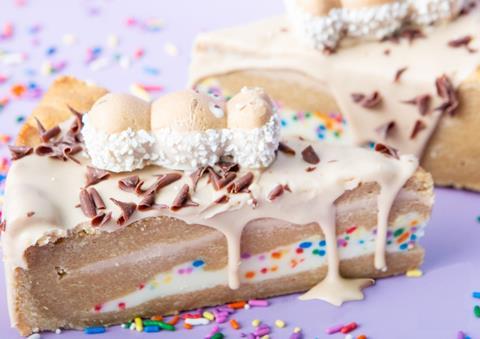
Funfetti Kinderella Cookie Pie
- 225g Unsalted Softened Butter
- 150g Light Brown Sugar
- 100g Caster Sugar
- 2 Large Eggs
- 2 tsp Vanilla Extract
- 350g Plain Flour
- 1 tsp Bicarbonate of Soda
- ½ tsp Baking Powder
- Pinch of Salt
- 200g Cocoa King White Chocolate Chips
- 500g Cocoa King Kinderella Spread
- 80g Get Baked Rainbow Sprinkles
1. Preheat your oven to 170°C Fan / 190°C.
2. Line an 8-inch (20cm) deep round cake tin with baking paper.
3. Cream together the butter, light brown sugar and caster sugar until pale, light and fluffy.
4. Beat in the eggs one at a time, then stir through the vanilla extract, fold in the flour, bicarbonate of soda, baking powder and salt until a soft cookie dough forms.
5. Mix through the cocoa king white chocolate chips and rainbow sprinkles.
6. Press just over half of the cookie dough into the base and slightly up the sides of the tin to create a shell.
7. Spoon 350g of Kinderella Spread into the centre, spreading it evenly while leaving a 2cm border around the edge.
8. Cover with the remaining cookie dough, gently sealing the edges to keep the filling enclosed
9. Bake for 32–36 minutes or until golden around the edges and lightly coloured on top.
10. Allow the cookie pie to cool in the tin for 30-45 minutes before removing
11. Warm remaining Kinderella Spread and drizzle over the top along with white chocolate chips, rainbow sprinkles, and Kinder Bueno pieces (optional)
To view this recipe and more, head over to Cocoa King’s website.




No comments yet