











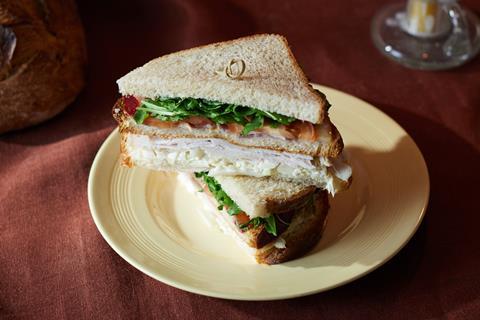
Out-of-home sandwiches are generally saltier than those sold in supermarkets with some loaded with high levels of hidden salt, new research has found.
Campaign and research group Action on Salt & Sugar published results of its recent survey on 546 sandwiches, wraps, rolls and baguettes sold in UK supermarkets and high street chains. Food businesses were expected to meet the voluntary salt reduction targets two years ago, yet one in ten sandwiches were found to still exceed the salt and calorie levels set out in the official guidance.
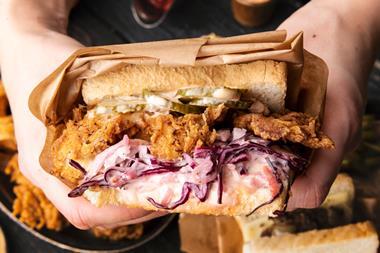
The survey discovered the worst offender to be Gail’s Smoked Chicken Caesar Club, which contains 6.9g of salt per serving. Launched earlier this year as part of Gail’s winter range, the sandwich contains 1,067 calories and 18g of saturated fat while providing 20% of an adult’s recommended fibre intake at 6.1g.
The wider picture was equally poor, according to Action on Salt & Sugar – a third of sandwiches it surveyed would receive a red traffic light warning on front of pack labelling for saturated fat, and more than one in seven were high in fat, saturated fat and salt simultaneously.
Raising concerns on the health impact of out-of-home lunches were other high in salt menu options including Gail’s Smoked Salmon Bagel with Schmear and Pickled Pink Onions (4.2g of salt); Paul’s Rosette Cheese Salami Gherkin (4.2g), and Pret a Manger’s Ham & Grevé Baguette (3.9g). Sandwich offerings from major retailers were generally found to contain less salt, although there were still some that had particularly high levels of salt such as Tesco’s Fully Loaded Hot Honey Halloumi, Falafel & Pickled Slaw (3.8g) and Sainsbury’s Kitchen Deli Pastrami, Cheddar Cheese & Gherkin Mustard Mayo (3.7g).
Additionally, significant differences in salt levels were identified between similar products. For example, Pret a Manger’s Chicken Salad Sandwich (2.2g) versus Greggs’ Roast Chicken Salad Sandwich (1.1g), or M&S All Day Breakfast Sandwich (2.7g) versus Sainsbury’s All Day Breakfast Sandwich (1.5g).
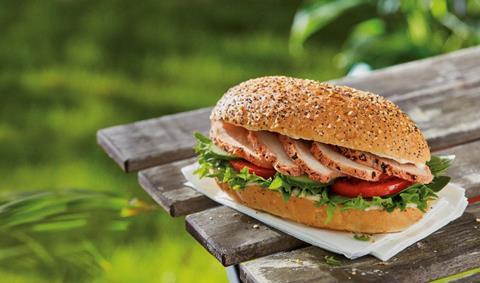
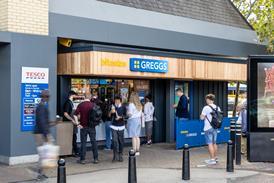
The survey did find some companies that were getting it right, though. Pollen + Grace, The Gym Kitchen, and Urban Rajah met calorie and salt reduction targets, and had no red warning labels on front of pack. Within retailers, Asda and Lidl achieved full compliance to the salt targets for sandwiches, and Starbucks and Greggs provided the lowest average salt levels in the OOH sector, with full compliance with the salt and calorie targets, according to the campaign group.
It also highlighted how reformulation was both possible and practical in terms of salt reduction, pointing to Subway’s Veggie Delite Sub (0.6g of salt), Pret a Manger’s Avo, Olive & Toms Half Baguette (0.8g), Caffè Nero’s Chicken, Tomato & Basil Hot Wrap (1.1g), and Greggs’ Tuna Mayonnaise & Cucumber Sandwich (1.1g).
Coming in the midst of Salt Awareness Week (11 to 17 May), the group of experts at Action on Salt & Sugar are calling for ministers to get serious about salt reduction by making it a clear public health priority again. That includes urgently reviewing the outdated salt reduction targets, introducing tougher mandatory limits through the Government’s Healthy Food Standard, and backing them with financial penalties for companies that fail to comply.
“Most people choose sandwiches for lunch for their simplicity, convenience and affordability. But what they’re actually eating can be a full day’s worth of salt hidden between two slices of bread,” commented Sonia Pombo, head of research and impact at Action on Salt & Sugar, a non-profit organisation based at Queen Mary University of London.
“More than 20 years after the first set of salt reduction targets were introduced, it’s frankly unacceptable that some companies continue to sell sandwiches that exceed an adult’s daily limit in one go,” added Pombo. “Voluntary action has been allowed to drift for too long, and the result is a food environment that continues to put public health at risk. The Government must now step in with tough, mandatory measures, because leaving this to industry goodwill has clearly failed.”
A stronger focus on health-led innovation is expected to play out in the sandwich market, driven in part by the growing use of weight-loss injection, although the new products are said to emphasise fibre, gut health, and more nutrient-dense ingredients rather than salt reduction.






No comments yet