









From sandwich fillers and sweet treats to cakes and enriched doughs, eggs remain a staple ingredient across the bakery sector. But increasingly, buyers are looking beyond functionality and cost to consider how those eggs are produced.
According to the latest EggTrack report from Compassion in World Farming (CIWF), global food and drink companies have made significant progress towards using cage-free eggs.
Monitoring the progress of the ‘most influential’ food companies against their cage-free commitments, the 2025 iteration found that the average cage-free transition now stands at 85%, reflecting a steady increase from the 75% reported in the last Global EggTrack in 2023.
Nearly 30% of businesses (168) are now fully cage-free across all egg categories in their supply, with 71 businesses achieving this milestone since the 2023 report, including Compass Group UK&IRE, Caffè Nero, The Restaurant Group, and Tesco UK.
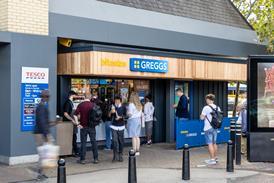
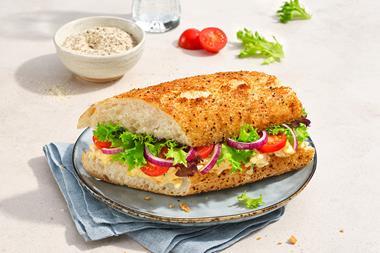
Greggs is also among this group sourcing all of its eggs from 100% free-range sources as part of its commitment to higher welfare standards. This is communicated to consumers with products named to highlight their welfare credentials, such as the Free Range Egg Mayo Sandwich and Free Range Egg Pot accompanied by descriptions noting that they’re ‘free range because we care about happy hens’.
Notably, not all manufacturers and food companies are included in the EggTrack report, but many have cage-free commitments as part of their sustainability strategies. For example, sweet bakery manufacturer Baker & Baker has committed to using cage-free eggs across its entire portfolio from the end of 2027, and Associated British Foods saw its volume of cage-free eggs by weight rise from 44% in 2024 to 56% in 2025 in the UK and Ireland.
However, progress remains patchy in some areas, highlighting the practical and financial challenges that businesses continue to face as they work towards higher welfare standards.
Of the 415 commitments with a 2025 deadline noted by the EggTrack report, only 48% (198) have been fulfilled. While many companies have fallen short of their target, 29% of missed 2025 commitments have already achieved at least 75% cage-free, indicating strong progress towards full compliance although 217 commitments remain unmet, CIWF added.
Case study: Puratos

Bakery and patisserie supplier Puratos is among those to have fallen behind. In 2020 it committed to sourcing 100% cage-free eggs globally by the end of 2025, but a statement on the firm’s website from May 2026 noted that progress towards this goal has been “slower than expected”.
This, it said, reflects the complexity and global scope of the supplier’s operations with several external factors – including global avian flu outbreaks, regional supply shortages, and varying levels of customer willingness to absorb the additional cost of cage-free eggs – also playing a part.
As such, its conversion to cage-free eggs has stabilised at 35% in 2025, although 100% of its products within the UK use cage-free eggs.
While the supplier strives towards an updated goal of 100% cage-free eggs across all markets, except South America, by the end of 2030 it is also working to reduce its overall reliance on the ingredient.
“As providers of bakery and patisserie ingredients, we use eggs in some of our products and remain committed to continuously improving our sourcing practices to minimize adverse impacts,” it said. “At the same time, we believe our greatest contribution lies in reducing the overall reliance on eggs across the industry. Through our egg-reducing and egg-replacing solutions, we actively support our customers in lowering their use of eggs, helping to drive change at scale. We will continue to expand these solutions, as this is where we can have the most meaningful impact across the value chain.”
Puratos adds that it has steadily reduced the total volume of eggs and egg products it purchases, even as global production volumes increased. In 2025, it prevented 782,848,158 eggs being used. With this in mind, the business has set a long-term objective to reduce the use of eggs across the market by the equivalent of 1 billion eggs by the end of 2030.
Supply chain challenges
Transitioning entire supply chains can be a tough egg to crack but with regulation changes on the horizon using cage-free eggs might not always be a voluntary commitment for firms.
According to the latest Defra data (Q1 2026), 17.4% of eggs for human consumption came from hens in enriched cages, while 71.3% were free range.
“Although the UK banned conventional battery cages in 2012, ‘enriched’ cages remain legal,” said CIWF. “However, several European countries have already banned or are phasing out all cages for laying hens, creating regional momentum that influences UK policy and retailer expectations.”
As part of its Animal Welfare Strategy for England published in late 2025, the government outlined its objective to work with industry to phase out the use of enriched cages for laying hens. At present, colony cages are legally required to have nest boxes, litter and perches. However, the strategy noted that these cages do not fully provide for the physical and behavioural needs of the birds, as in these systems the birds do not have full freedom to express normal behaviours.
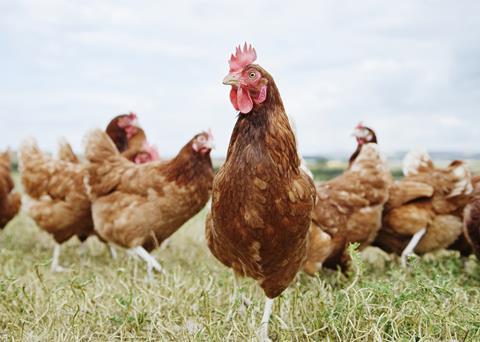
Defra noted that it was already supporting the transition to cage-free systems through grants for laying hen and pullet farmers in England with flocks of 1,000 birds or more, to refurbish or replace existing housing, including those transitioning from colony cages to high welfare non-cage systems.
It added that this transition has been accelerated by the major retailers’ pledge to stop selling shell eggs from hens kept in colony cages by the end of 2025 – with some retailers extending their 2025 pledge to processed egg, such as powdered or liquid.
Companies that have postponed their cage-free transition are now facing a combination or pressures, according to CIWF, including delays in planning permission for new or upgraded barns, cheaper imports undercutting domestic producers, and more complex supply chains for egg ingredients compared with shell eggs, requiring greater resources and planning. It also highlights rising food inflation, financial pressures linked to avian flu, and the ongoing cost of living crisis.
“These challenges are significant – but they also highlight the importance of early action,” said the CIWF. “Companies that made commitments several years ago had time to plan strategically, invest, and spread the costs over longer periods. Those that delayed are now paying the price – financially and reputationally. Even so, the overall UK trend is moving in the right direction, with year-on-year increases in cage-free production in the UK.”
Case study: Dr. Schär

Dr. Schär is one such company as CMO Hansjorg Prast, who is responsible for the manufacturer’s sustainability strategy, notes it began the transition to cage-free eggs in 2016.
The move forms part of the firm’s wider sustainability strategy, sitting under its commitments to biodiversity and sustainable agriculture. “For us, safeguarding animal welfare is part of our daily commitment because we believe that respect at every stage of production translates into the value and quality of what reaches people’s tables,” says Prast.
The transition was “carried out through a clear process that included all necessary organisational steps, such as budgeting, planning, and supplier selection”. The latter, Prast highlights, is “particularly important” as suppliers “must be chosen based on quality, guarantees, and their ability to consistently deliver raw materials that meet our standards”.
As such, the gluten-free specialist, which has 18 sites across 11 countries, completed its switch to eggs exclusively from barn-raised hens in 2025.
“As the transition began ten years ago, most of our products had already been produced with barn eggs for some time, as noted on our packaging,” Prast adds. “We know that our consumers value our brand for many reasons, including our commitment to keeping our promises.”
On the right track
While progress is moving forward in eggs, some are changing tact when it comes to chickens. CIWF’s ChickenTrack 2025 report, published in March 2026, pointed out that several companies including KFC, Nando’s, and The Restaurant Group left the Better Chicken Commitment (BCC) in which they pledged to stop using fast-growing chickens, for an industry-led plan without that commitment.
They instead joined the Sustainable Chicken Forum (SCF), to ‘drive the next phase of welfare progress with an approach that helps to answer the challenges facing the poultry supply and hospitality sectors’. The SCF noted that focus on slower-growing breeds alone, as required by BCC, ignores the knock-on impacts of these breeds in the poultry supply chain.
However, CIWF assures that the risk of companies backtracking on cage-free egg commitments is “significantly lower”.
“The egg supply chain is very different from broiler production, and the UK has already made clear, measurable progress toward a fully cage free market. More than 80% of UK eggs are now cage free, and both science and consumer sentiment strongly support higher welfare systems,” it adds.
“There is also growing momentum for regulatory action through the UK’s Animal Welfare Strategy, which further reinforces the direction of travel. Taken together, these factors make it unlikely that companies will reverse their cage free commitments.”
Free range and beyond
Moving from cage-free to barn eggs is only one step in the journey with free range and organic, which have even higher welfare standards, following on.
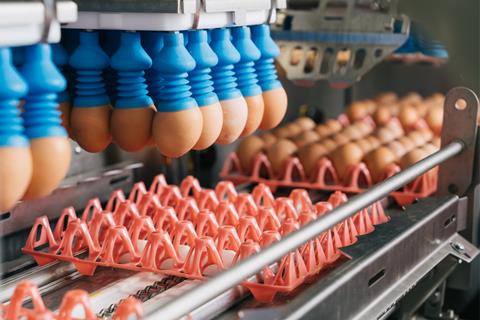
According to UK law, to be officially classed as free-range, hens must have outdoor access continuously during daytime and provide at least 4m² per hen at all times. Most free-range hens on commercial farms live in buildings like the barn system but have access to the outside through ‘pop holes’. Organic hens are generally part of a much smaller flock; up to 3,000 hens, compared to a maximum of 16,000 free-range hens, and under Soil Association standards each hen is allowed a minimum of 10m² of space outside with more pop holes to encourage them to get outside.
Rebecca Tonks, CEO and founder of St. Ewe Free Range Eggs says demand from branded manufacturers and premium bakery producers for its products is “strong and structurally increasing”. The leaders in this area, Tonks adds, are the bakeries which “market quality, provenance, and ethical sourcing as part of their brand proposition” as well as those that need to account for customer trust around ingredient quality and provenance.
Indeed, the firm has recently invested in a brand-new £13m facility in Cornwall to produce a range of liquid eggs for foodservice operators and bakeries using eggs sourced from its 70-acre farm near St Austell and its network of other family farms across the Southwest and Wales.
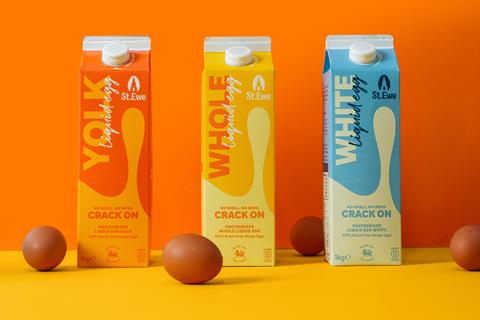
Cost is undoubtedly a factor when choosing which ingredients to use in baked goods, but Tonks says the impact on final product cost isn’t as dramatic as some might think.
“The exact premium fluctuates significantly with feed costs and supply-demand balances – a free-range egg ingredient could carry a premium of around 10–30% versus eggs from caged systems, however the gap can be both smaller and larger depending on environmental and market conditions,” she explains. But as eggs are just one component a recipe alongside other costs such as packaging, energy, and labour, “a 20% premium on the egg ingredient might translate into only a low single-digit increase in the total manufacturing cost of a premium cake or biscuit”.
Looking to the future, things could get more costly as other considerations come into the mix.
While there is a four-tier system for eggs currently in place – enriched cages, barn, free range, and organic – the conversation is likely to move toward a “more detailed, tiered and elevated welfare standards and broader sustainability metrics”, according to Tonks who says “free-range is increasingly becoming the baseline expectation in UK food production and supply chains”.
“Differentiation is shifting toward higher-welfare systems with greater focus on measurable factors like space, enrichment, husbandry practices and use of artificial intelligence to improve welfare, productivity and proactive farming,” she explains. “There is growing interest in linking welfare to environmental outcomes, including regenerative agriculture although these ideas are still emerging and lack consistent standardisation.”






No comments yet