



The unrelenting rise in labour costs is so challenging for bakeries that even the smallest are now having to adopt some level of automation. Yet there are solutions that can help them not just survive but thrive in a constantly changing market.
With employment one of the biggest hurdles facing UK bakeries over the past few years, the situation only seems to be worsening, as a combination of the rising national minimum wage (NMW), the national living wage (NLW) and business rates, as well as low awareness among younger generations about the opportunities in the sector, continue to dog staff recruitment and retention.
As reported in British Baker, in April this year, the NMW will go up by 8.5% for 18- to 20-year olds, and 6% for 16- to 17-year-olds or apprentices, while the NLW will rise by 4.1%, creating what bakery trade bodies have described as an “impossible trading environment”. And that’s just the tip of the iceberg. In the same article, Craft Bakers Association (CBA) chief executive Karen Dear noted that while “small bakeries are the backbone of the UK’s food landscape, Government policy is squeezing them from every direction”, adding that without employer relief on the NMW and national insurance, many bakeries will be forced into reducing hours, cutting jobs or closing sites. She referenced the CBA’s recent sector-wide survey which showed that wage bills had moved up £10k-£50k in the last year, with 100% of bakeries having to raise prices just to survive, and over a third having stopped replacing staff.
The growing need for bakery automation
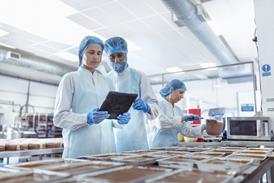
For small and medium-sized enterprises (SMEs), in particular, the labour issue has come to a head, with staff shortages creating difficulty in scaling up production and sales, while competition for reliable and efficient workers is at an all-time high. Even smaller, traditional family firms that have prided themselves on quality handcrafted products are feeling the pressure and are realising the need for a certain level of automation on their production lines to be able to continue to operate.
“For bakeries to survive in this day and age, they have to keep their costs to a minimum. And the only way to do that is to automate”
– Paul Johnson, head of Fritsch UK
To the smallest bakeries, the thought of any type of automation might have seemed inconceivable only a short while ago, with the concept associated as the domain of larger industrial manufacturing plants. However, the cost of adopting some level of automation, compared with the soaring costs of manual manufacture, are making a strong case for investment – particularly if a bakery wishes to scale up and future-proof its business. In another BB article, David Moore, ESG director for The Compleat Food Group summed it up succinctly, saying: “Automation is increasingly becoming a strategic investment for bakeries of all sizes – not just to boost speed, but to solve practical challenges around labour, consistency and sustainability.”
Skills shortage is a real issue in the sector, too. At Multivac, head of subsidiary company Fritsch UK Paul Johnson reflects what is happening out in the market. “For bakeries to survive in this day and age, they have to keep their costs to a minimum,” he says. “And the only way to really achieve that now is to automate. What I find myself talking to customers about most is the lack of a generation of people coming through to work in bakeries. I’m sure that, if you had an average room full of 30 school-leavers or graduates, none of them are going to suggest that they want to go into bakery. It’s a real shame that the next level of workers is just not coming through. So, the competition for labour cannot be understated. And where loyalty might once have kept workers employed at the same venue for many years, the ability to earn an extra 10p an hour with an employer down the road now makes a huge difference.”
He cites a recent visit to a bakery, which he says has been going for 50+ years. “They told me they just cannot get hold of staff, while the people you can get hold of do not have the necessary skills needed to work in a bakery. We’re finding bakeries like these are now more likely to want to invest in automation whereas, perhaps even five years ago, it wasn’t on the cards. Automation enables them to redeploy their existing labour to other tasks in the bakery.”
Often, he says, these bakeries are run by the owners, as opposed to the larger industrial bakeries, where the factory or plant manager would oversee the production line. While he has cited the example above, Johnson is quick to point out that the problem exists right across the country, with many of the machinery equipment company’s customers having to adapt to more rapid changes in the market – not just in terms of scaling up production, but taking into account the need for innovation to respond to ever-changing market trends and consumer demand.
Why flexibility is so important
For SME bakeries, therefore, automating processes doesn’t just need to ramp up the speed of an operation; flexibility is also a key factor in any equipment investment, as a single line might be required to handle multiple products that could range, for example, from sausage rolls to Danish pastries. As such, rapid turnover and quick clean-down of equipment are must-haves. At the same time, smaller businesses are still keen to keep the traditional and handmade artisan look and quality of their products – not just for the goods themselves, but the packaging in which they are housed.
“Taking away the human element reduces the likelihood of mistakes happening or products that are out of spec”
– Paul Johnson, head of Fritsch UK
Meanwhile, all of this development also needs to take into consideration consistency of the product, efficiency on the production line, and reduction of waste to meet increasingly stringent expectations in the market – both from regulators and consumers. In this sense, there is a clear advantage to automation, as consistency comes as a given. “By taking away that human element, automated product handling means you are reducing the likelihood of mistakes happening or having products that are out of spec,” says Johnson. “If a bakery is selling to retailers, they want the product to look the same every single time. And it has to retain a consistent size to fit in the allocated packaging – whether it be flow-wrap or a thermoformed pack, for instance.
“With enhanced automation, bakeries can eliminate some of the steps along the production line, as well as the movement around it. You are naturally reducing the need for more people to be part of that process.”
With small to medium-sized bakeries increasingly automating, they are also going to want equipment that will allow them to scale up over time, to make the most of their investment, points out Johnson. “They will want to allow for future capacity increases,” he says. “Labour-intensive production limits throughput, while automated processes are much quicker.”
How Fritsch can help
Where Fritsch UK aims to help out is with modular equipment that will suit both small and medium-sized bakeries looking to minimise costs, achieve consistency and quality of product, and enable growth for the longer-term.
As an example, Johnson points to the company’s Rollfix dough sheeter, which can produce laminated dough sheets within minutes. The Rollfix, with its powerful drive system, can handle dough blocks of up to 20kg and offers flexible dough thicknesses due to millimetre-precision roller gap adjustment.
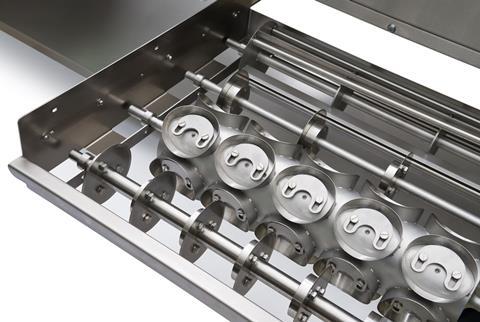
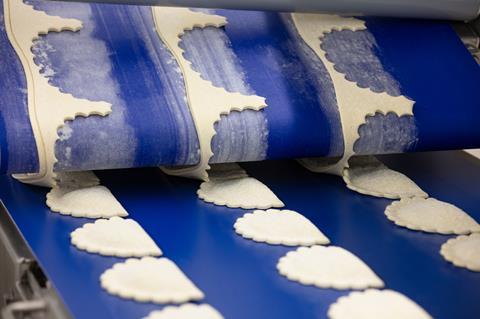
Meanwhile, the company’s Variocut S/M 700 offers easy and weigh-accurate production of a wide range of artisan-quality bakery products, from croissants to Danish pastries to pizzas, for example. Stainless steel cutting rollers allow precision cutting, minimising scrap dough and thereby waste reduction. “You can produce different shapes of pastry, such as a circular pie lid, a triangle to make croissants which you then roll up manually, or a pizza base, for example,” says Johnson. “It’s a relatively low-cost solution for bakeries to adopt.”
As a next step up, he suggests the extendable Varioflex M700 line, enabling production of a wide variety of pastries. With a small footprint suited to small and medium-sized bakeries, its motor-driven guillotine provides high cycle rates and precise cutting accuracy. Specialised accessories allow users to tailor the line to their requirements, and its modular flexible framework allows the addition of infeed and downstream technology to suit different applications.
At the end of the day, continuing to run a successful business in the increasingly competitive UK bakery landscape will come down to controlling costs and optimising margins. So whatever size of operation, the return on investment needs to be swift “At Multivac UK, we can offer finance packages and payment terms to suit most customers; investing in automation does not need to be seen as cost-prohibitive,” adds Johnson.
Without wanting to be too cliched or dramatic, Johnson sums up: “I think it comes down to ‘adapt or die’,” he says. “Bakeries have to adapt to the micro and macroeconomics they cannot control. I see bakeries of all sizes embracing the need for change – and our equipment will give them the flexibility to make the products they want and expand at the speed they want.in a very competitive industry.”
To see Fritsch’s bakery technology in action, see the video below: