








Every day, UK bakeries overproduce to avoid running out – and write off the excess at the end of the day. It is a rational response to an impossible planning challenge. AI is changing that equation entirely.
The problem with ultra-fresh
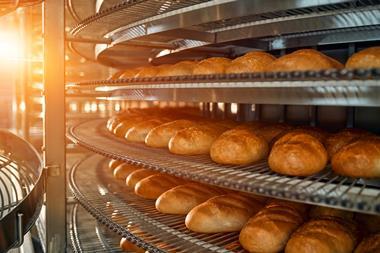
There is no category in food retail more unforgiving than ultra-fresh. A loaf of bread, a filled roll, a pastry fresh from the oven – these products have a window of hours, not days, in which they can be sold. Miss that window and the margin is gone. There is no markdown strategy that fully recovers it.
According to WRAP, bakeries could prevent up to 75,000 tonnes of food waste every year simply by getting production planning right. For bakeries already operating on tight margins, that daily write-off is not a rounding error. It is a structural problem sitting at the heart of the business.
Why conventional bakery planning falls short
Spreadsheets, historical averages, and the instinct of experienced bakers are all valuable but they cannot account for the full complexity of what drives demand on any given day. Weather changes footfall. Local events shift purchasing patterns. A bank holiday behaves differently from a regular Monday. A city centre site performs nothing like a suburban high street. These variables interact in ways that no spreadsheet can reliably model.
The result is a sector that systematically overproduces to avoid running out, and systematically writes off the excess. It is a rational response to an impossible planning challenge – but it is not the only response available.
Food waste gets the headlines, but it’s downstream of a deeper issue. The industry simply doesn’t have enough qualified staff to manage demand, inventory, and production properly. The fewer experienced people there are to make complex production calls at 5am, the more the business leans on guesswork. The more waste, gaps and missed sales follow.
The cost of getting it wrong
UK bakeries are operating in one of the most challenging cost environments in a generation. Flour, butter and energy prices have risen sharply. Wage costs have increased. Every unit that comes out of the oven now costs more to produce than it did five years ago, which means every unit thrown away at the end of the day hits harder than it used to.
Bakeries are caught between two forces: the cost of overproducing and the cost of undersupplying. Customers who find an empty shelf don’t wait, they go elsewhere. In the current environment, getting that balance wrong is simply no longer affordable.
A different class of solution
But what if there was a solution that could help solve these problems – in a way that fits into the way bakeries work, not asking them to change the way they work to fit the technology? This is the problem Foodforecast Technologies was founded to solve. Established in Cologne by Justus Lauten, founder, and Jan Brormann, co-founder, the company began developing its forecasting technology in 2019, working in close collaboration with bakery businesses from day one. From the beginning the team worked alongside bakers, production managers and operations teams, learning how bakeries actually function, how decisions get made at 5am, and how the consequences of a bad forecast land immediately on the business.
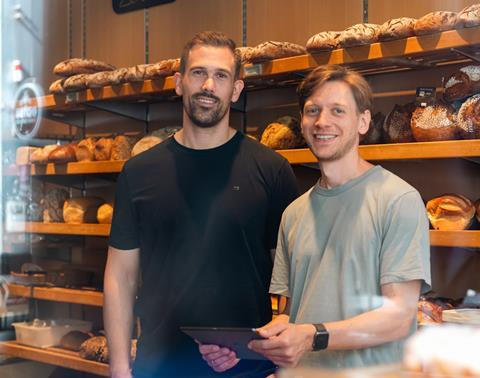
“Ultra-fresh food requires an entirely different class of forecasting technology. Our AI doesn’t just look at yesterday’s sales – it learns the unique demand patterns of every single site and gets smarter over time”
– Justus Lauten, Founder & CEO, Foodforecast Technologies
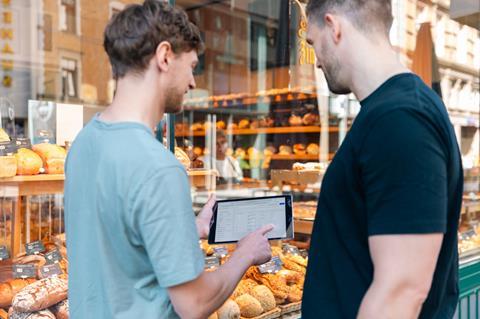
The result, launched commercially in 2022, is an AI-powered demand and production forecasting platform that connects directly to a bakery’s existing ERP, POS and EPOS systems. Its machine learning models pull in historical sales data – sales history, order data, return data – and layer it with external variables: weather forecasts, local events, school holidays, seasonal patterns, day-of-week behaviour. Every factor that influences how many croissants sell on a wet Wednesday morning versus a sunny Saturday is factored in automatically.
The quality of the forecast is only ever as good as the data feeding it. In ultra-fresh, the margin for error is as narrow as the shelf-life of the product itself. As the platform learns, patterns invisible to the human eye – a consistent uplift every time a nearby school has an inset day, a dip in savoury sales whenever rain is forecast before noon – are identified and built in automatically. Over time the system builds a data asset unique to each site that no manual process could replicate.
Foodforecast provides intra-day forecasting, giving teams the information they need, when they need it.
Built for the data-driven bakery
For bakeries looking to digitalise, demand forecasting is the highest-impact place to start; it touches every part of the operation, from purchasing and staffing to waste and revenue. Unlike broader digital transformation projects, implementing Foodforecast requires no replacement of existing systems and no disruption to the way the bakery runs. The data the platform needs is already there – in the till, in the ERP, in the order history. Foodforecast simply puts it to work. For businesses that have been considering digitalisation but haven’t known where to start, this is a low-risk, high-return entry point.
What changes when planning is accurate?
The impact of concise planning is felt across the whole operation. Less overproduction means lower ingredient costs. Better availability means more sales captured at peak. And by automating the most complex planning decisions, the platform takes pressure off teams that are already stretched thin. Experienced staff can focus on the craft, not the spreadsheet, and the business is less dependent on hard-to-find expertise.
“Across thousands of locations in Europe we’ve proven that better forecasting directly improves margins. The UK has the same challenges and opportunity. We’re here now because the timing is right and the need clear”
– Jan Brormann, Co-Founder, Foodforecast Technologies
Foodforecast is already live across more than 5,000 bakeries and operators in Europe. Results vary by operation, but top-performing customers have seen:
● Up to 34% reduction in food waste
● Up to 11% increase in sales
● Over 90% of manual planning processes automated.
Whether you have four stores or 100, the technology scales to your operation – and Foodforecast guarantees an added value of at least 10 times your investment in the platform.
The UK opportunity
The UK bakery market is one of the most dynamic and competitive in Europe – and one of the most exposed to the ultra-fresh planning challenge. The technology is proven at scale across four European markets.
Foodforecast’s expansion philosophy is built on a clear principle: technology travels, but markets are won by people. The UK trade has its own language, its own regional patterns, its own ways of working. A city centre in Newcastle is not the coast of Cornwall. A Glasgow high street trades differently to a Welsh market town. A London commuter rush is nothing like a Saturday morning in the Lancashire mill towns. And the products themselves are just as regional. A morning roll in Glasgow, a stottie in Newcastle, a bara brith in Wales, an Eccles cake in Lancashire. Every region has its own habits, its own products, and its own demand patterns. Forecasting that works has to fit how UK bakeries actually run, not the other way round. That’s why the UK rollout is led by Greg Nixon, UK Lead. He brings a deep understanding of the market and its different regions.
The integration is straightforward. The results are measurable. And for UK bakeries prepared to make the move, the competitive advantage of getting production planning right while others are still relying on spreadsheets and instinct is significant and immediate.
Foodforecast is now expanding into the UK, backed by €8m in Series A investment from leading European impact investors SHIFT Invest and ECBF. The question for UK bakeries is not whether AI-powered forecasting will become the industry standard, it is whether you move first or play catch-up.
Get in touch
Ready to find out what Foodforecast Technologies could do for your bakery? Speak to Greg Nixon, UK Lead, to discuss a free trial offer tailored to your business – and find out how quickly you could start seeing results. www.foodforecast.com/en/contact